Two-ram balers are one of the most significant capital equipment purchases a recycling operation, MRF, or high-volume distribution center will make. The price range is wide - and the number most people find online is either outdated or doesn't paint the full picture of what machines actually sell for. This post gives you real numbers, explains what drives price up or down, and breaks down total cost of ownership so there are no surprises after you sign.
HMS sells, refurbishes, provides parts, and services two-ram balers across North America. These numbers reflect what we actually see in the market in 2026 - not manufacturer list prices from five years ago.
The Short Answer: Price Ranges at a Glance
New two-ram baler
Entry-level two ram models from major manufacturers start around $240,000. Large wide-body or high-capacity configurations with full options packages can reach $800,000+. There are multiple options in between these two price figures.
- Full manufacturer warranty (typically 1 year parts and labor)
- 16 to 24 week lead time from order to delivery
- Section 179 tax deduction eligible in the year of purchase
- Financing available through most equipment lenders at competitive rates
Refurbished two-ram baler
Refurbished two-ram balers from a dealer with in-house reconditioning capability span a wide range depending on size, brand, age, and the scope of work performed. A thoroughly refurbished machine with updated controls, new hydraulic components, and a fresh reline & knives sits at the higher end of this range. A machine that received lighter service work sits lower.
- Limited dealer warranty - scope varies; always ask for specifics in writing
- 12 to 16 week delivery in most cases
- Best value when purchased from a dealer who did the refurbishing in-house
- Can often be financed on 3 to 5 year terms through equipment lenders
Used as-is two-ram baler
As-is machines are sold without reconditioning. Price reflects the machine's age, condition, and how motivated the seller is. The gap between as-is and refurbished pricing looks attractive on paper - but unknown repair costs can close that gap quickly. A machine that needs a full reline, hydraulic overhaul, and controls upgrade can cost $80,000 to $150,000+ in service work on top of the purchase price.
- No warranty or very limited seller guarantee
- Pre-purchase inspection is essential
- Harder to finance through traditional equipment lenders
- Best suited to buyers with strong in-house mechanical capability or a trusted service partner
A $75,000 as-is two-ram that needs a $70,000 reline, $20,000 in hydraulic work, and a new control system isn't a deal - it's a $200,000 machine you didn't know you were buying. Always get a full inspection before committing to an as-is purchase.
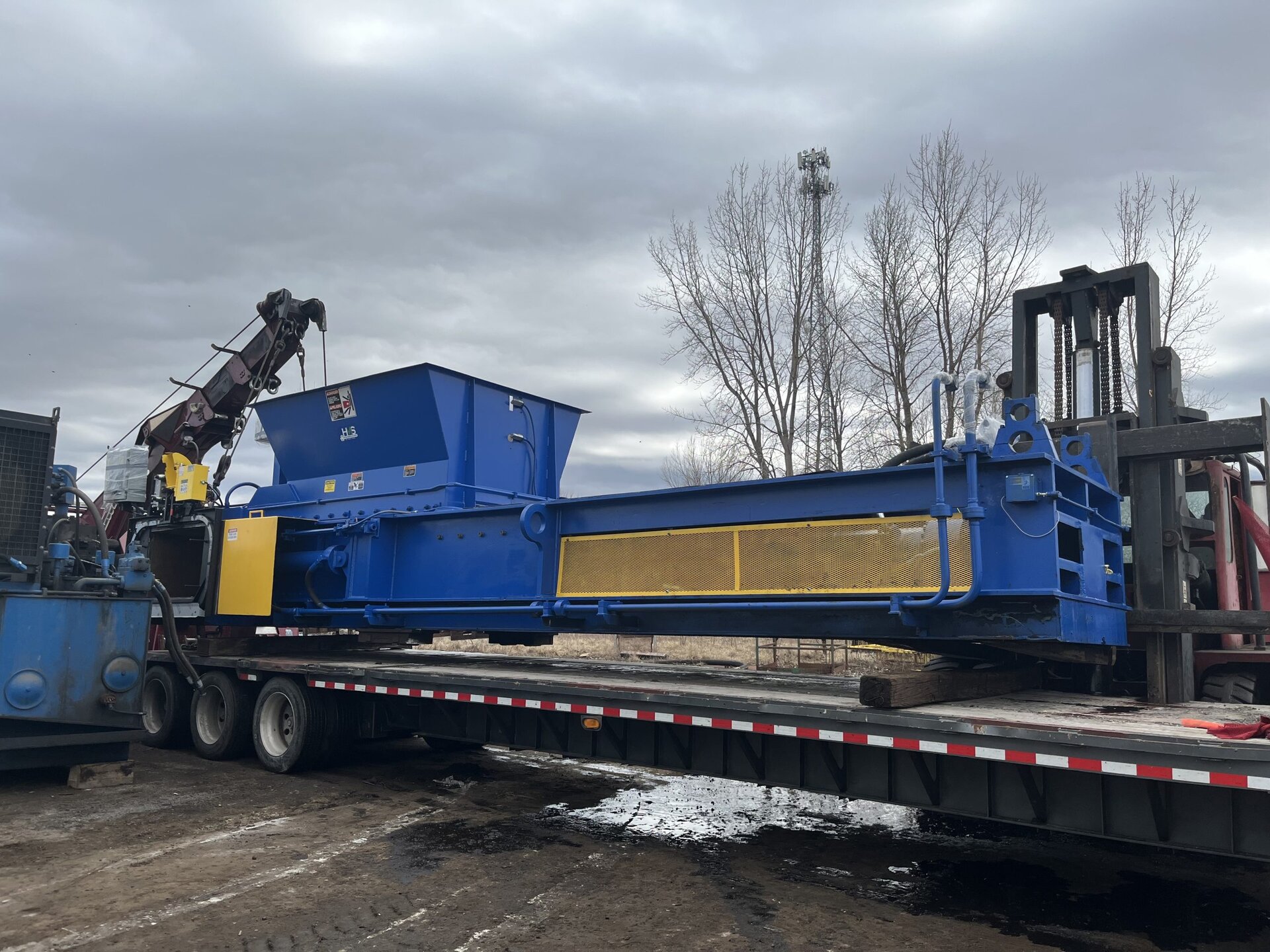
What Drives the Price Up or Down
Two-ram baler pricing is not arbitrary. Every major cost driver comes down to one of six factors. Understanding them helps you evaluate quotes and purchase the correct machine for your operation.
1. Horsepower and motor configuration
Horsepower is one of the most direct drivers of price. Entry-level two-ram machines run 30 to 50 HP. Mid-range machines run 75 to 100 HP. High-capacity units run 150 - 200 HP, sometimes with dual motor configurations. More HP means faster cycle times and more tons per hour - but also a higher price tag, higher operating costs, and a larger electrical service requirement. Match HP to your actual volume needs for current and future growth.
2. Cylinder size - the most important spec on the machine
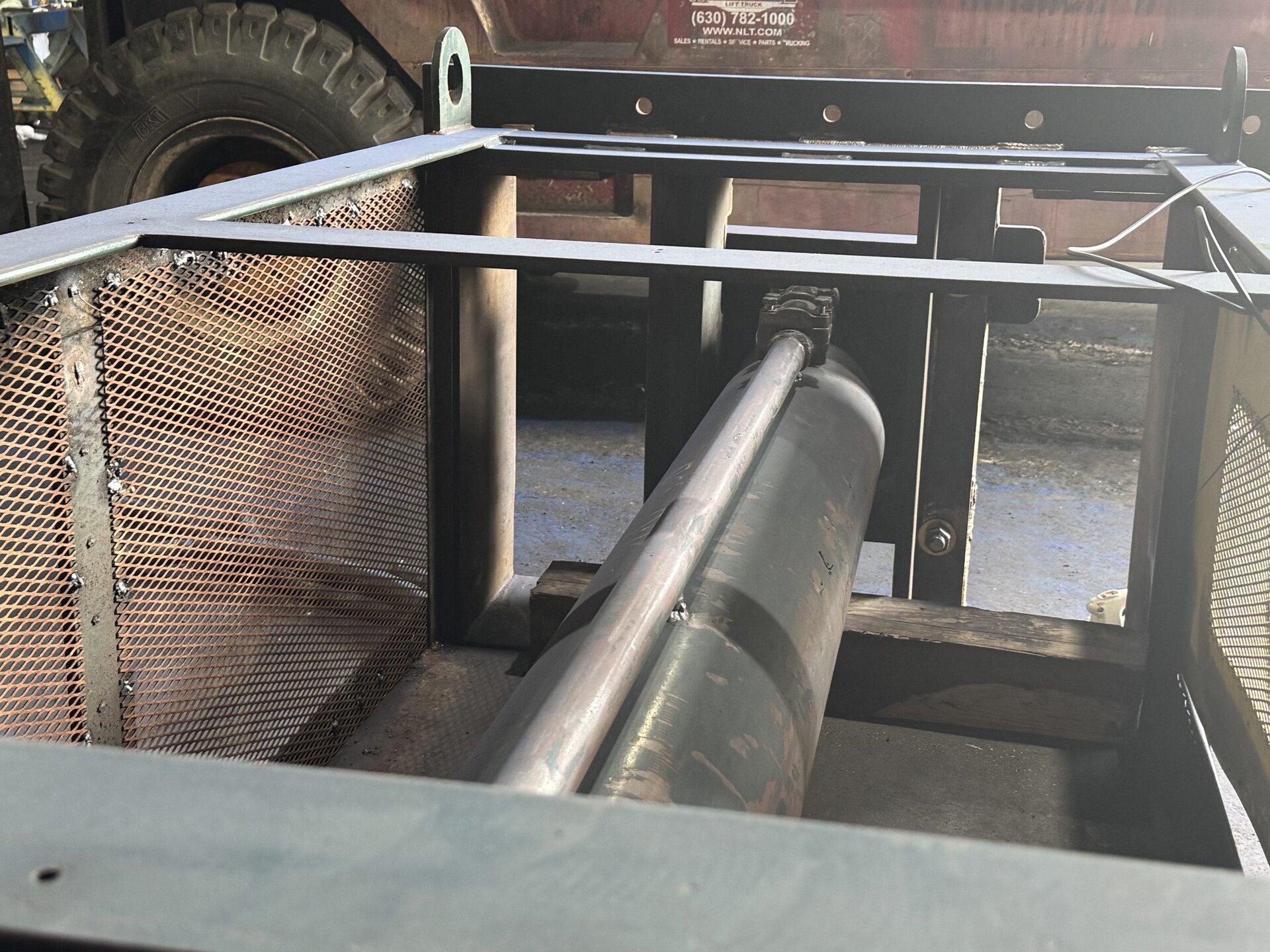
If there is one number that tells you more about a two-ram baler than any other, it is the main cylinder bore diameter. This is not a secondary spec - it is the core of the machine's capability and one of the most important factors in price, performance, and long-term value.
A two-ram baler has two cylinders: the main gatherer cylinder and the eject cylinder. Both matter, but the main cylinder is what determines how much force the machine can actually apply to the material in the bale chamber.
Main cylinder bore diameter directly determines compaction force. A larger bore produces more tons of force at the same hydraulic pressure. More force means denser bales, better material penetration, and the ability to handle difficult materials that smaller machines can't compress effectively.
Main cylinder: what the numbers mean
Main cylinder bore sizes on two-ram balers typically run from 8 inches on smaller narrow-body machines up to 16 inches or more on large high-force models. Here is how the common configurations break down in practical terms:
- 8" to 9" main cylinder: Entry-level two-ram territory. Adequate for clean OCC, mixed paper, and plastics at moderate volumes. Ram force typically in the 150,000 to 193,000 lb range depending on system pressure. These machines are priced lower and appropriate for operations that don't need to fight difficult or bulky materials.
- 10" to 11" main cylinder: The most common configuration in the used market. Significantly more compaction force - typically 235,000 to 310,000 lbs - and better handling of mixed material streams including plastics, nonferrous metals, and bulkier OCC loads. This range is where most MRF and scrap yards operations land.
- 12" to 16" main cylinder: High-force machines designed for demanding applications - heavy mixed material, non-ferrous metals, or operations that need maximum bale density for commodity value. Ram force can exceed 400,000 lbs on the largest configurations. These machines command a significant price premium and require more robust electrical service, space requirements, and hydraulic systems to match.
When comparing two machines at similar prices, always check the main cylinder bore. A machine with a 10" cylinder and a machine with a 12" cylinder may carry similar price tags on paper, but they are not the same machine. The 12" will produce denser bales and handle a wider range of materials.
3. Bale chamber size and configuration
Narrow-body two-ram balers have smaller feed openings - appropriate for moderate-volume operations with consistent material. Wide-body machines have larger chambers, handle oversized or bulky materials more easily, and produce heavier bales. Wide-body machines cost more upfront but often deliver better bale revenue per ton.
4. Wire tier system
The wire tier is one of the most maintenance-intensive components on a two-ram baler and one of the most important. If the wire tier does not work, the baler is down. When evaluating a used machine, always ask what the tier system is and whether it has been rebuilt or replaced.
5. Control system and automation level
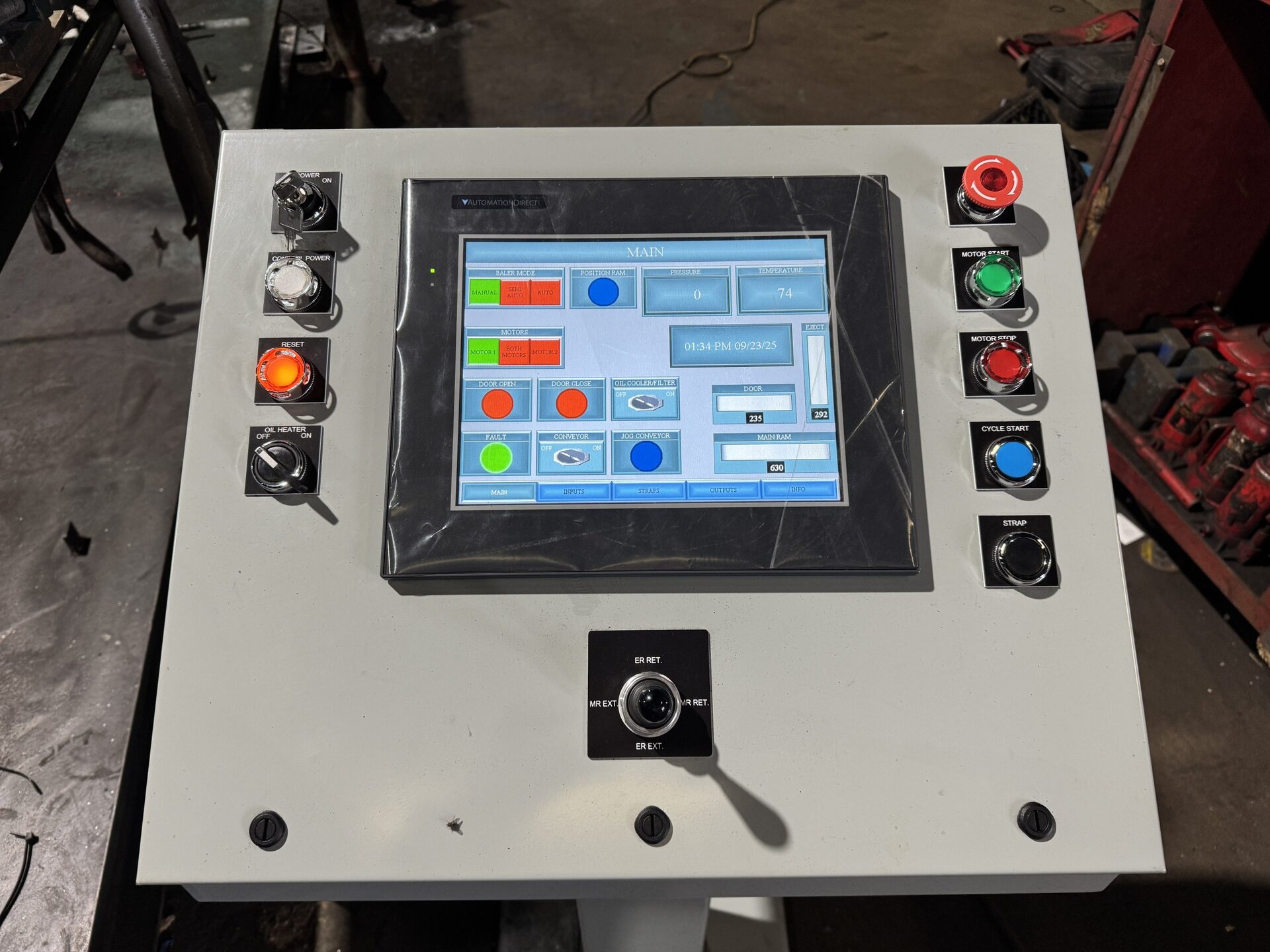
Modern two-ram balers run PLC-based control systems with touchscreen interfaces, diagnostic displays, and remote monitoring capability. Older analog machines are mechanically simpler but lack diagnostic capability and can be harder to troubleshoot. When HMS reconditions a used two-ram, we typically replace analog controls with a new PLC and touchscreen - it adds cost but significantly improves reliability, uptime, and bale weights. Ask specifically about the control system when evaluating any used machine.
6. Manufacturer and availability
Harris, Excel, Selco, Mosley, IPS, and Marathon are the most common two-ram manufacturers you will encounter in the used market. Parts availability, service network, and machine longevity are a critical component to consider. When something fails, you want to be able to source a replacement cylinder seal or pump cartridge quickly. Less common brands or older machines may be priced attractively but can create parts delays that cost you more in downtime than you saved on purchase price.
The Full Cost of Ownership - Beyond the Purchase Price
The purchase price is only the starting point. These are the additional costs you need to budget before your first bale.
| Cost item | Typical range | Notes |
|---|---|---|
| Installation and commissioning | $15,000 - $25,000+ | Depends on site complexity, rigging requirements, and electrical work needed. Should be included or clearly quoted by your dealer. |
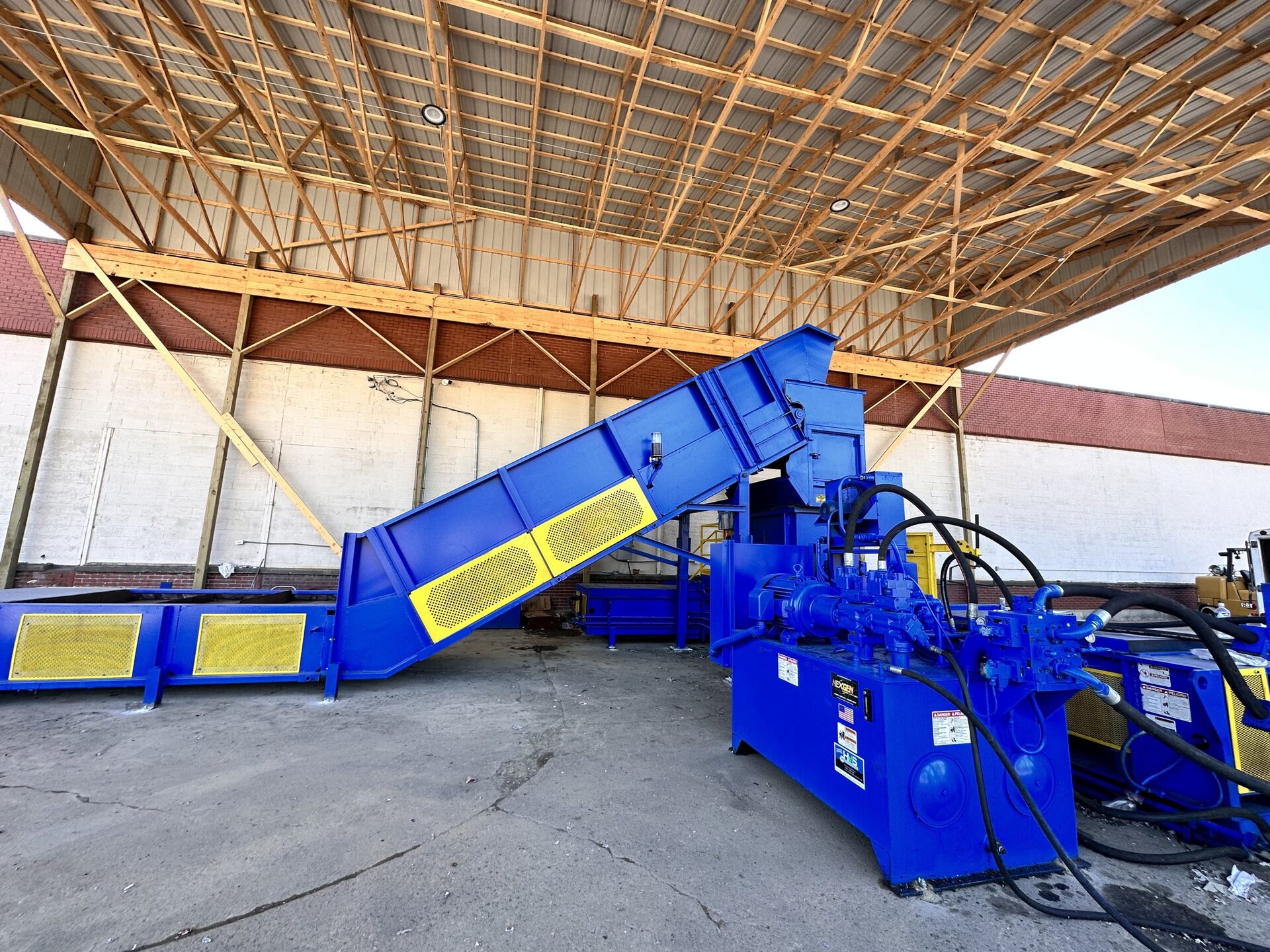
| Conveyor infeed system | $50,000 - $250,000+ | Most two-ram installations require a conveyor infeed. Length, width, and drive configuration affect cost. Often sold in same package with the baler. |
| Baling wire | $5,000 - $20,000+ per year | Wire cost depends on bale count, wire gauge, and number of ties per bale. |
| Routine maintenance | $2,500 - $10,000 per year | Hydraulic fluid, filters, wear parts, tier components, and annual PM. Varies significantly by usage hours and material type. |
| Floor reline | $40,000 - $100,000 | Two-ram baler floors & walls wear over time and must be relined periodically. Frequency depends on material abrasiveness and tonnage. Plan for this every 5 to 10 years. |
A fully installed two-ram system - machine, conveyor, freight, installation, and commissioning - typically costs $20,000 to $45,000 more than the baler & conveyor purchase price alone. Budget for the full system, not just the machine.
New vs. Refurbished: The Real Financial Comparison
The decision between new and refurbished is rarely just about sticker price. Here is how the full financial picture compares for a mid-size operation looking at a 150 HP two-ram.
| Factor | New | HMS Refurbished | As-Is Used |
|---|---|---|---|
| Purchase price | $240,000 - $800,000 | $125,000 - $400,000 | $60,000 - $250,000 |
| Warranty | 1 year full manufacturer | Limited dealer warranty | None |
| Near-term repair risk | Very low | Low - addressed in reconditioning | High - unknown condition |
| Lead time | 16 - 20 weeks | 12 - 16 weeks | 1 - 4 weeks |
| Controls | Current PLC / touchscreen | Updated PLC / touchscreen (HMS standard) | May be analog / outdated |
| Financing | 5 - 7 year terms common | 3 - 5 year terms available | Difficult through traditional lenders |
| Best for | High-volume ops, long-term financing, warranty priority | Budget-conscious buyers who need reliability | Buyers with strong in-house service capability |
For most operations, a properly refurbished two-ram baler represents the best balance of cost, reliability, and speed to first bale. The key word is "properly" - which means the dealer did the work in-house, stands behind it with a real warranty, and has technicians who can support you after the sale.
For a deeper look at how to evaluate each condition category, see our full guide: New vs. Used vs. Refurbished Balers: How to Decide.
What HMS Includes in a Reconditioned Two-Ram
Not all reconditioned machines are equal. When HMS reconditions a two-ram baler, here is what that actually means - because buyers should ask this question of any dealer, not just us.
- Full mechanical teardown and inspection: Every major component is assessed before reconditioning begins. Machine is dissambled to its frame to prepare for rebuild. We document what we find and share it with the buyer.
- Hydraulic system service: Cylinders are inspected and repacked or replaced. Hoses, pumps, fittings, and filters are replaced. Fluid is changed. System pressure is tested and verified against manufacturer spec.
- Wire tier rebuild or replacement: The tier is one of the highest-wear components on a two-ram. We rebuild or replace it as needed and test through multiple full cycles before the machine ships.
- Controls upgrade: Analog control systems are replaced with a new PLC and touchscreen display. Laser travel sensors are installed on cylinders. Digital sensors replace mechanical switches where applicable.
- Floor and liner inspection: Floor, walls, and other wear liners are replaced. New OEM knives are installed. Structural issues are repaired, not painted over.
- Break-in and testing: Every machine goes through testing before it is prepped, painted, and shipped.
What to ask any dealer before buying a reconditioned two-ram
Did you recondition this machine, or are you reselling it? Brokers often list machines as "reconditioned" when they simply cleaned and painted them. Ask for documentation of the work performed.
What does your warranty actually cover? Get it in writing. A warranty that covers labor but not parts - or parts but not cylinders - is not the same as a real warranty.
Who services the machine after the sale? A dealer with in-house technicians can support you when something goes wrong. One that refers service out loses accountability the moment the machine leaves their yard.
How to Evaluate ROI on a Two-Ram Baler
A two-ram baler is a major capital investment. Before you sign, run the math on what it will actually return. Here is a simple framework.
Revenue side
Calculate your expected monthly bale revenue: tons per day x operating days per month x OCC market price per ton. At 20 tons per day, 22 operating days, and $100 per ton OCC, that is $44,000 per month in gross commodity revenue. Subtract hauling and handling costs to get net revenue.
Cost reduction side
Estimate your current monthly hauling cost for loose or compacted cardboard. A two-ram operation producing dense bales typically reduces pickup frequency by 60 to 80 percent compared to a compactor or dumpster operation. That reduction goes directly to your bottom line.
Labor savings
A two-ram with conveyor infeed dramatically reduces the labor hours spent on cardboard handling per shift. Calculate the dollar value of those hours at your fully-loaded labor rate and add it to your ROI calculation. This is often the most underestimated line item in the financial case for a two-ram.
Most operations running 25 or more tons of OCC per day see full payback on a refurbished two-ram within 12 to 36 months. Operations running 50+ tons per day with current commodity prices often see payback inside 12 months.
Frequently Asked Questions
New two-ram balers typically start around $240,000 for smaller narrow-body models and can reach $800,000 or more for large wide-body or high-capacity configurations. Two of the biggest pricing variables are main cylinder bore diameter - which ranges from 8 inches on entry-level machines to 16 inches or more on high-force models - and horsepower. A larger main cylinder produces significantly more compaction force and commands a higher price.
Refurbished two-ram balers from a reputable dealer with in-house reconditioning typically range from $125,000 to $400,000 depending on size, brand, and the scope of reconditioning performed. As-is used machines can be found for less, but carry unknown repair costs that can quickly erase the savings. Always ask what was replaced, what the warranty covers, and who did the work.
Beyond the purchase price, two-ram baler ownership costs include installation and commissioning ($15,000 to $25,000+), conveyor infeed system if needed ($50,000 to $250,000+), routine maintenance ($2,500 to $10,000 per year), and periodic floor relines ($40,000 to $100,000 every several years depending on usage). Budget for the full system, not just the machine.
Yes - when purchased from a dealer who reconditioned the machine in-house. The key questions are: what was replaced, what does the warranty cover, and who did the work? A properly reconditioned two-ram baler from a dealer with an in-house service team can deliver years of reliable service at 40 to 60 percent of new cost. HMS refurbishes all machines at our Wanatah, IN facility and backs them with a real dealer warranty.
Bottom Line
Know the full number before you negotiate
A two-ram baler is not a commodity purchase. The machine price is just the start - installation, conveyor, wire, and maintenance all add up to a number that can be 10 to 20 percent higher than the baler price alone. Run the full math, including total cost of ownership and realistic ROI, before you evaluate any specific machine or quote.
HMS carries new, refurbished, and as-is two-ram balers from Harris, Excel, Marathon, and other major manufacturers. We refurbish machines in-house at our Wanatah, IN facility and service them after the sale. If you want a straight answer on what a machine should cost and whether a specific unit is worth what someone is asking, call us.
Have a specific machine in mind, or want to know what's in stock? Our team will give you a straight answer.