Distribution centers and warehouses generate more cardboard waste than almost any other operation type - and they have specific constraints most generic baler guides completely ignore. Dock configuration, shift schedules, labor availability, peak season volume swings, and plastic film all affect which machine actually makes sense for your facility.
This guide is written specifically for DC and warehouse operations. We'll cover the right baler type for your volume, how to think about labor and automation, what OCC bale quality means for your bottom line, and the questions you need answered before you sign anything.

The DC Cardboard Problem Is Bigger Than Most Operations Realize
A mid-size distribution center handling 50 to 200 inbound truckloads per day can easily generate 10 to 40 tons of OCC per day. Without a baler, that cardboard gets broken down by hand, stuffed into compactors or dumpsters, and hauled away at whatever frequency keeps the dock from overflowing. The cost of that approach - in labor hours, hauling fees, and lost OCC revenue - is significant.
Consider what loose cardboard actually costs you:
- Labor: Breaking down and moving loose cardboard is one of the most time-consuming tasks on a dock. At 20 to 30 minutes per ton manually, a 15-ton-per-day operation burns 5 to 7 hours of labor daily on cardboard alone.
- Hauling costs: Loose cardboard in a compactor or dumpster requires frequent pickups - often 3 to 5 times per week for a mid-size DC. At $200 to $500 per haul, that adds up fast.
- Lost revenue: OCC bales typically sell for $50 to $150 per ton depending on the market. A DC generating 15 tons per day is walking away from $750 to $2,250 per day in potential revenue.
- Space: Loose cardboard is bulky and unpredictable. It takes up dock space that should be moving product, not staging waste.
A properly sized baler pays for itself through a combination of reduced hauling costs and OCC revenue. Most distribution centers reach full payback within 12 to 36 months. After that, the machine generates net positive cash flow every month it runs.
Understanding OCC - Your Most Valuable Recyclable
OCC - Old Corrugated Cardboard - is the single most important recyclable material for most DC and warehouse operations. It is consistently one of the highest-value fiber commodities in the recycling market, but bale quality matters enormously for what you actually get paid.
Recyclers and paper mills pay a premium for clean, dry, dense OCC bales. Contaminated bales - ones that contain plastic, food waste, or wet material - get downgraded significantly or rejected outright. This means how you run your baler and how you train your team directly affects your revenue per ton.
- Keep it dry: Wet cardboard drops in value and can be rejected. Stage cardboard away from dock doors during wet weather before baling.
- Keep it clean: No plastic film, strapping, or food-contaminated boxes in the OCC stream. Train dock staff on what goes in the baler and what doesn't.
- Dense bales pay more: A well-maintained baler with proper ram pressure produces consistently dense bales. Loose, underweight bales cost you money on every load.
- Know your buyer: Establish a relationship with a local recycler or broker before you start baling. Knowing your market price helps you evaluate your ROI accurately.
Which Baler Is Right for Your DC?
The honest answer depends on three things: your daily OCC volume, your labor model, and whether you also generate plastic film. Here are the four main horizontal and vertical options and who each one fits.
Vertical Baler
Compresses cardboard downward with a single hydraulic ram. Operator loads manually, ties the bale by hand when full, and ejects it. Straightforward to operate and maintain.
- Right for: Smaller DCs or warehouses generating under 3 tons of OCC per day
- Cost: $15,000 to $25,000 new; $3,000 to $10,000 used
- Labor: Requires an operator for loading and manual tying - plan for 1 to 2 hours of active labor per day at moderate volumes
- Footprint: Small - fits against a dock wall or in a corner without major space commitment
- Limitation: Cannot keep pace with high-volume operations; manual tying becomes a bottleneck above 3 tons per day
Horizontal Manual-Tie Baler
A horizontal baler that compresses material the same way as an auto-tie, but requires an operator to manually thread and tie the wire before the bale ejects. Lower upfront cost than auto-tie with the same horizontal throughput advantage over a vertical.
- Right for: Mid-size DCs generating 5 to 10 tons of OCC per day where labor availability is not a constraint and upfront cost needs to be controlled
- Cost: $120,000 to $180,000 new; $65,000 to $90,000 refurbished - meaningfully less than auto-tie
- Labor: Requires an operator present for each bale tie - less hands-off than auto-tie but more productive than a vertical at higher volumes
- Throughput: Comparable to auto-tie for compression; tying time is the rate limiter at high volume
- Good middle ground: For operations that want horizontal capacity without the full auto-tie price tag, manual-tie horizontal balers are a solid and often overlooked option
- Limitation: Labor dependency on tying makes it less efficient than auto-tie above 10 tons per day; not ideal for lean staffing models
Horizontal Auto-Tie Baler
Material feeds continuously into a hopper, gets compressed horizontally, and the bale is automatically tied and ejected out the side. Once running, this machine operates with minimal hands-on involvement per bale.
- Right for: Distribution centers generating 5 to 40+ tons of OCC per day; the workhorse of the industry for this application
- Cost: $150,000 to $300,000 new; $95,000 to $125,000 refurbished from a reputable dealer
- Labor: Very low per-bale labor - one person can manage feeding while doing other dock tasks; auto-tie handles bale completion
- Throughput: Most mid-size horizontal auto-tie units handle 15 to 40 tons per day comfortably; high-capacity models go higher
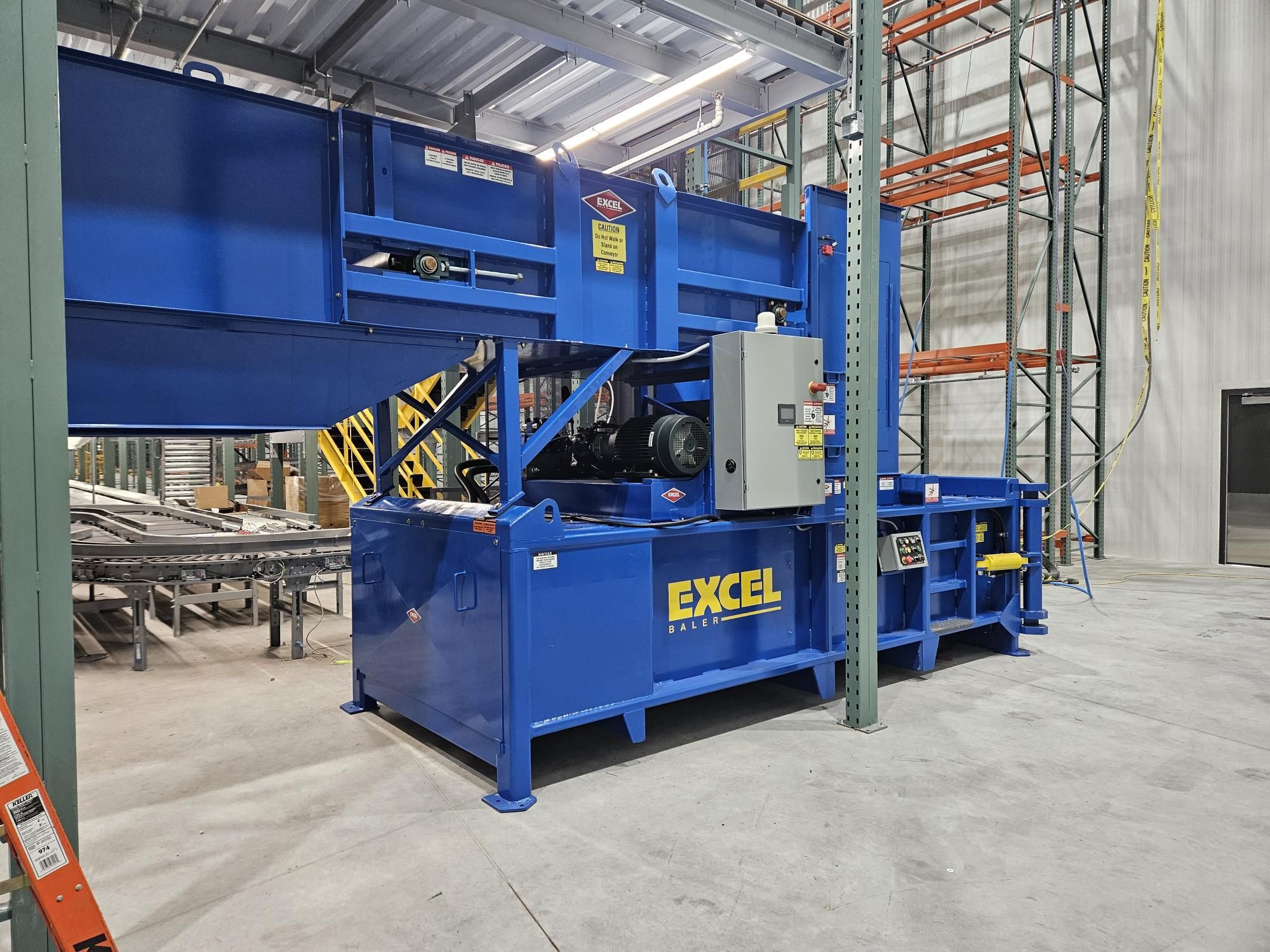
- Conveyor integration: These machines pair well with conveyor infeed systems, allowing cardboard to be fed directly from the dock without manual carrying
- Limitation: Requires more floor space than a vertical; less flexible with heavily mixed or contaminated material streams
Two-Ram Baler
Uses two independent hydraulic rams - one to compress, one to eject. Handles a much wider range of materials than a single-ram machine and produces the densest, most consistent bales.
- Right for: DCs generating 10 to 40+ tons per day; operations that also bale significant plastic film, large OCC, or mixed materials alongside cardboard
- Cost: $240,000 to $400,000+ new; $125,000 to $400,000 refurbished
- Labor: Can run nearly unattended with conveyor infeed
- Limitation: Significant capital investment; overkill for operations where volume is primarily OCC at moderate levels
Don't Overlook Plastic Film
Most distribution centers don't just generate cardboard. Pallet stretch wrap, poly bags, bubble wrap, and other plastic film materials accumulate alongside OCC - and they create a real problem if you're not handling them separately.
Plastic film cannot go into a standard cardboard baler without contaminating your OCC bales and reducing their value. Your options are:
- Separate film baler or densifier: A dedicated film densifier processes stretch wrap and poly film into high-density logs or pellets that are sold separately. This keeps your OCC stream clean and adds another revenue line.
- Baler with film capability: Vertical balers, horizontal manual tie balers, and two ram balers can often handle mixed OCC and film streams.
- Manual separation and third-party pickup: Some operations separate film manually and arrange periodic pickup by a film recycler. This works at low volumes but becomes labor-intensive at scale.
If plastic film is a significant part of your waste stream, factor that into your baler decision from the start. Retrofitting a solution later almost always costs more than planning for it upfront. HMS carries equipment for both OCC and film streams - talk to our team about what makes sense for your full material mix.
Conveyor Integration - The Step Most DCs Skip
The baler itself is only part of the solution. How cardboard gets to the baler is just as important - and it's where most DC operations leave efficiency on the table.
Without a conveyor, dock workers break down boxes and carry or cart them to the baler manually. At low volumes this is manageable. At 10+ tons per day it becomes a significant labor drain and creates bottlenecks during peak receiving periods.
A conveyor infeed system - typically a slider bed conveyor running to the baler hopper - allows cardboard to be placed on the conveyor at the point of unloading and fed to the baler continuously. The benefits are:
- Labor savings: Workers don't leave their area to manage cardboard. One person can feed the baler while managing other tasks.
- Peak capacity: During high-volume receiving periods, a conveyor keeps the cardboard moving instead of piling up on the floor.
- Bale consistency: Continuous feeding produces more consistent bale density than batch loading, which improves OCC bale quality and value.
- Safety: Reduces manual carrying and cart traffic in dock areas, which are already high-traffic zones.
If your DC receives 30 or more truckloads per day, a conveyor infeed system is almost always worth the investment. The labor savings alone typically justify the cost within the first year. HMS designs and installs complete conveyor and baler systems - not just the machine.
Sizing Your Baler: Volume Thresholds That Actually Matter
The most common sizing mistake is buying for average daily volume instead of peak volume. A DC that averages 10 tons per day might hit 25 tons during peak season. A baler sized for the average will fall behind during the periods when you need it most.
| Daily OCC volume | Recommended baler | Conveyor needed? | Typical payback |
|---|---|---|---|
| Under 3 tons/day | Vertical baler | Usually not | 12 - 24 months |
| 3 - 7 tons/day | Horizontal manual-tie or auto-tie | Optional but helpful | 12 - 24 months |
| 8 - 20+ tons/day | Horizontal auto-tie | Recommended | 12 - 18 months |
| 25 - 60+ tons/day | High-capacity horizontal auto-tie | Yes | 6 - 14 months |
Size for your peak volume, not your average. If you're uncertain where you fall, track your cardboard output for two to four weeks - ideally across both a slow period and a busy one - before talking to a dealer.
New vs. Refurbished for Distribution Centers
Most distribution centers we work with end up in one of two buckets: operations that want a new machine with full warranty coverage and long-term financing, and operations that need equipment quickly and want to control upfront cost.
The refurbished case for DCs
A refurbished horizontal auto-tie baler from a dealer with an in-house service team is one of the best value purchases in industrial recycling equipment. The machines are mechanically straightforward, built to last, and parts are readily available for all major brands.
What to look for: Make sure the dealer reconditioned the machine in-house - not a broker who bought it and cleaned it up. Ask what was replaced, what the warranty covers, and whether their service team can reach you when something goes wrong.
HMS reconditions all used equipment at our Wanatah, IN facility. Every machine is inspected, hydraulic systems are serviced, wire tiers are tested, and electrical controls are verified before anything ships.
For a deeper look at how to evaluate new vs. refurbished vs. as-is, see our full guide: New vs. Used vs. Refurbished Balers: How to Decide.
What to Ask Before You Buy
Whether you're buying from HMS or anyone else, these questions will help you evaluate what you're actually getting.
- What is the machine's rated throughput per hour, and how does that match my peak daily volume? Ask for throughput at your specific material - OCC throughput differs from mixed paper or plastic.
- Who installs it, and what does installation include? Commissioning, operator training, and initial setup should be part of the deal - not a surprise add-on.
- What does the warranty cover and for how long? Get specifics - hydraulics, wire tier, electrical, frame. A warranty that covers only certain components isn't the same as a full machine warranty.
- Who do I call when something goes wrong at 6am on a Monday? Find out if the dealer has in-house technicians or refers service out. Response time matters when your dock is backed up.
Frequently Asked Questions
It depends on daily cardboard volume. Distribution centers generating under 3 tons per day can typically manage with a large vertical baler. Operations generating 4 to 30+ tons per day are best served by a horizontal manual tie or auto-tie baler. Always size for peak volume, not average - a machine that falls behind during your busiest weeks creates bigger problems than one that has occasional idle capacity.
Vertical balers suitable for smaller warehouses range from $15,000 to $25,000 new. Horizontal auto-tie balers for mid to large distribution centers run from $150,000 to $300,000 new, or $95,000 to $125,000 refurbished from a reputable dealer with in-house reconditioning. Most distribution centers see full payback within 12 to 36 months through reduced hauling costs and OCC revenue. At 15 tons per day with OCC trading at $100 per ton, a baler can generate $1,500 per day in gross commodity revenue before hauling costs.
Yes - typically within 1 to 3 years for most distribution center operations. The payback comes from two sources: reduced waste hauling costs (baled cardboard requires far fewer pickups than loose material) and revenue from selling baled OCC to recyclers, which typically trades at $50 to $150 per ton depending on the market. Labor savings from reduced manual cardboard handling add a third source of ROI that is often underestimated at the point of purchase.
OCC stands for Old Corrugated Cardboard - the primary recyclable material generated by distribution centers and warehouses. It is one of the most consistently valuable recyclable commodities on the market. Bale quality matters: contaminated or wet OCC bales fetch significantly less per ton, and heavily contaminated loads can be rejected outright. A properly sized and maintained baler with trained operators produces clean, dense bales that maximize your OCC revenue every load.
Bottom Line
The right baler turns cardboard from a cost into a revenue stream
Distribution centers and warehouses are sitting on one of the most consistently valuable recyclable commodities in the market. The right baler - properly sized, correctly integrated, and maintained by a service partner who actually shows up - turns that cardboard from a hauling expense into a monthly revenue line.
HMS has been selling, installing, and servicing baling equipment for DC and warehouse operations across North America since 2004. We carry horizontal manual tie balers, horizontal auto-tie balers, two-ram balers, vertical balers, and conveyor infeed systems - new, refurbished, and as-is. And we handle installation and service in-house, which means one call when you need help.
Tell us your daily cardboard volume and we will recommend the right machine - no pressure, no upsell.