The horizontal auto-tie baler is the most widely used piece of recycling equipment in North America. Distribution centers, box plants, paper mills, printers, and MRFs all rely on it. But "horizontal auto-tie baler" covers a wide range of machines - from a 20HP narrow-bale unit suited for a moderate-volume box plant to a 225HP wide-hopper machine running 22 tons of OCC per hour at a major MRF. Understanding what separates one end of that range from the other is the most important thing you can do before you spend $100,000 to $300,000 on one.
HMS sells new Balemaster horizontal auto-tie balers and refurbishes units from Balemaster, American Baler, Maren, Marathon, IBC and IPS at our Wanatah, Indiana facility. This guide covers how these machines work, what drives cost, which operations they fit, and what to look for whether you are buying new or refurbished.
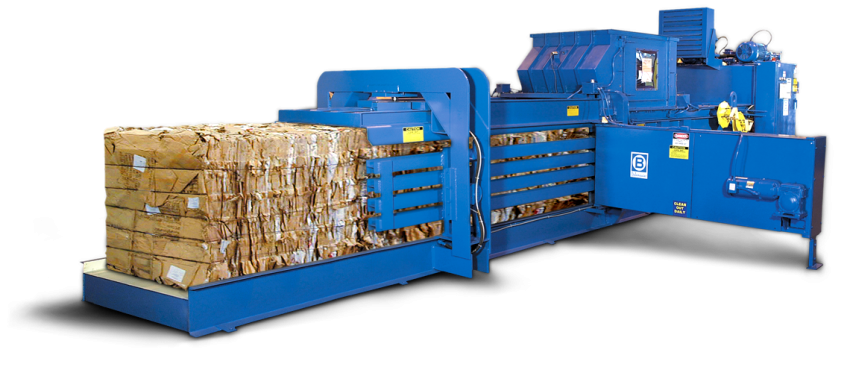
How a Horizontal Auto-Tie Baler Works
Understanding the machine cycle is useful context before evaluating any specific model - because the numbers that matter (ram thrust, throughput, hopper size) only make sense once you understand what each component actually does.
The baling cycle
Material enters the machine through a top-loading hopper - either manually loaded or fed by a conveyor or air system - and drops into the charging chamber below. The hydraulic ram, driven by a motor and pump system, cycles horizontally to compress the material in the charging chamber against the growing bale in the bale chamber. The ram retracts, more material drops in, and the ram cycles again. This continues until the bale reaches the set density or length.
The auto-tie cycle
When the bale is complete, the auto-tie system engages. Wire is threaded through machined slots in the ram face, passed around the bale, twisted or knotted to secure it, and cut - all automatically. On a Balemaster, the Auto-Ty cycle takes approximately 25 seconds from start to completion. Manual wire tie requires approximately 120 seconds per bale, which is why auto-tie pays for itself quickly in labor savings at any meaningful volume.
Bale ejection
Once tied, the bale is ejected out the end of the machine onto a bale discharge platform. The next cycle begins immediately. Because the machine feeds continuously - material can be loaded during the tie-off cycle - the horizontal auto-tie achieves higher throughput than machines that must stop feeding during each compression cycle.
On a Balemaster, the model number directly encodes the machine's dry capacity. Adding a zero to the model number gives you cubic feet per hour the ram travels through the charging chamber with no material. A Balemaster E-980 moves 9,800 cubic feet per hour at no load. This makes it easy to compare throughput capacity across models at a glance.
What the Key Specs Actually Mean
Horizontal auto-tie baler spec sheets list a lot of numbers. Here are the ones that matter most for evaluating any machine - new or used.
Motor horsepower
HP drives the hydraulic pump which drives the ram. More HP means faster cycles and higher throughput capacity. Horizontal auto-tie balers range from 20HP on smaller models up to 225HP on the largest. The right HP is the one that covers your peak daily volume with 25% to 40% capacity headroom - running a machine at its maximum rated capacity is a recipe for downtime.
Cylinder bore diameter
The hydraulic cylinder bore diameter determines ram thrust - the force the machine can apply to compress material. On horizontal auto-tie balers this ranges from 6 inches on smaller E-Series units up to 12 inches on heavy-duty EO-Series machines. An 8-inch cylinder at 3,000 PSI delivers approximately 150,900 lbs of ram thrust. A 10-inch cylinder delivers 235,500 lbs. A 12-inch cylinder at 3,000 PSI can deliver up to 339,300 lbs. More thrust means denser bales on demanding materials and better bale quality on difficult streams.
Bale size
Bale size (width x height x adjustable length) determines bale weight, transport economics, and compatibility with your commodity buyer's requirements. Common bale sizes range from 30"W x 36"H on smaller E-Series machines to 48"W x 40"H on larger EO-Series units. Larger bales weigh more per bale and reduce the number of bales per truckload, which can improve transport efficiency. Check with your OCC or commodity buyer before spec-ing bale dimensions.
Hopper and feed chute dimensions
The hopper opening determines what material can be fed and how - and whether a conveyor infeed is practical. Standard E-Series hoppers run 27 inches wide by 32 inches long. EO-Series hoppers run 45 inches wide by 60 or 75 inches long. A wider, longer hopper accepts larger or bulkier material and allows higher feed rates. If you plan to integrate a conveyor or air system, the hopper dimensions drive your width selection.
Number of bale ties
Most horizontal auto-tie balers use 4 or 5 wire ties per bale. The number and gauge of ties affects bale integrity, mill acceptance, and wire cost. Balemaster EO-Series machines run 4 or 5 ties depending on the group; E-Series runs 5 ties standard.
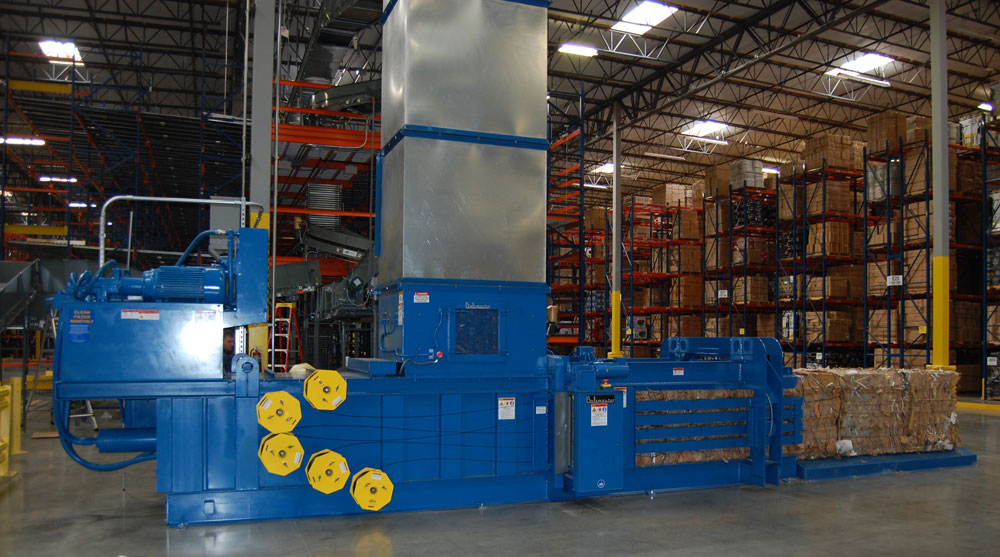
Balemaster: What HMS Sells New
HMS is an authorized Balemaster dealer. Balemaster - based in Crown Point, Indiana, about 30 miles from our Wanatah facility - manufactures what many operations managers consider the benchmark horizontal auto-tie baler in the industry. Their E-Series and EO-Series cover a wide range of throughput and bale size requirements.
The E-Series is Balemaster's flagship auto-tie baler line for moderate-volume, consistent material streams. The model number encodes dry throughput capacity (E-980 = 9,800 cu ft/hr). Standard and oversized hopper options are available. Bale density control is fully automatic. All E-Series models include manifold-mounted hydraulic valves, automatic bale length control adjustable in 1-inch increments, automatic balelocks, and a fully enclosed ram cycling chamber for dust control. Suited for: mid-size to large printers, corrugated box and sheet plants, folding carton plants, paper converters, envelope plants, recyclers processing aluminum cans or plastic bottles.
The EO-Series is the oversized hopper version of the Balemaster lineup - designed for higher throughput, larger bales, and more demanding material streams. Feed chutes run up to 75 inches long and 45 inches wide, enabling conveyor infeed at high material volumes. The 12-inch cylinder models (Group 8 and Group 19) deliver up to 339,300 lbs of ram thrust at 3,000 PSI with enhanced hydraulics - making them suitable for dense corrugated, aluminum cans, PET bottles, and high-density fiber streams. The 5200 Series EO-Series specifically targets corrugated box operations where capacity is the primary driver. Balemaster recommends sizing the machine at 2 to 3 times the actual required dock capacity to account for feeding variability.
What a Horizontal Auto-Tie Baler Costs
New horizontal auto-tie baler
New machines from Balemaster and other major manufacturers typically fall in this range depending on horsepower, cylinder size, bale dimensions, hopper configuration, and options. Entry-level E-Series models with smaller cylinders and standard hoppers sit at the lower end. Large-hopper EO-Series machines with 10" or 12" cylinders and enhanced hydraulics sit at the higher end. Lead time on new machines is typically 10 to 20 weeks from order.
Refurbished horizontal auto-tie baler
Refurbished horizontal auto-tie balers from HMS - rebuilt in-house at our Wanatah, Indiana facility - typically fall in this range. The price reflects our actual rebuild cost, which includes hydraulic service, wire tier rebuild or replacement, controls assessment and upgrade where needed, wear component replacement, and full functional testing before shipping. This is not a cleaned-up-and-painted price - it reflects real work performed on the machine.
A horizontal auto-tie baler is mechanically simpler than a two-ram baler - single hydraulic system, one ram, wire ties integrated into the ram face. That simplicity makes a well-refurbished horizontal auto-tie one of the best value purchases in recycling equipment. The machines are durable, parts are readily available for all major brands, and a thorough rebuild gets years of reliable service at a fraction of new cost.
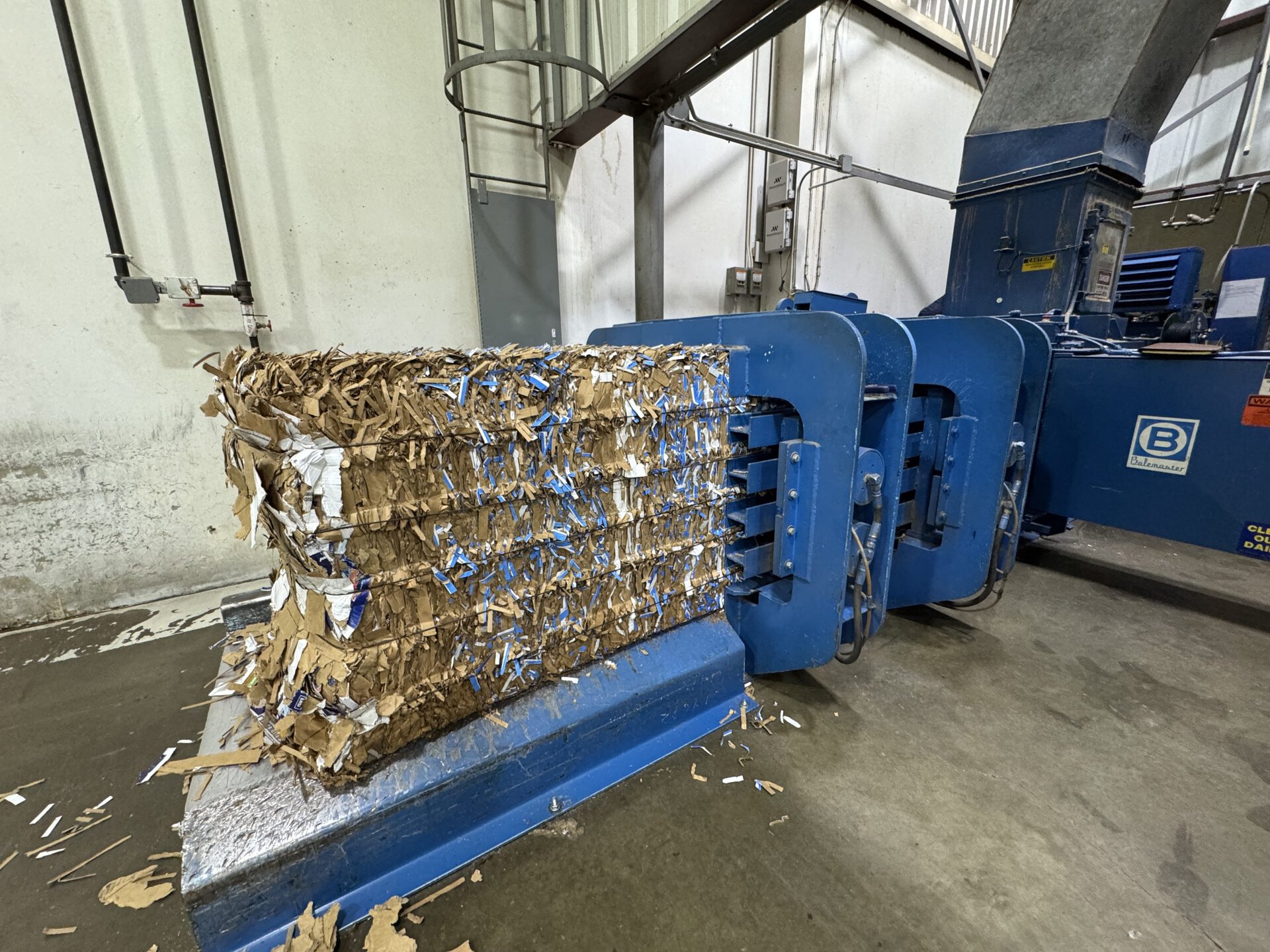
Refurbished Brands HMS Carries
HMS refurbishes horizontal auto-tie balers from all major manufacturers. We most commonly carry Balemaster and American Baler in stock. Here is how the brands compare:
- Balemaster - the machine HMS sells new and refurbishes. Crown Point, Indiana built. Known for durability, the Auto-Ty wire tier system, and parts availability. When HMS refurbishes a Balemaster, we know exactly what we are working with.
- American Baler - one of the most common horizontal auto-tie brands in the used market. Well-built machines with good parts availability. HMS carries refurbished American Baler units regularly and has extensive service experience on the platform.

Who the Horizontal Auto-Tie Baler Is For
The horizontal auto-tie baler is the right machine for a wide range of operations - but it is not right for every situation. Here is how to think about it.
Operations it fits well
- Distribution centers and warehouses generating 8 to 40+ tons of OCC per day. The auto-tie design minimizes labor per bale, pairs well with conveyor infeed, and produces consistent bales that maximize commodity revenue. This is the most common machine in this segment.
- Box plants and corrugated sheet plants processing OCC trim and broke at high throughput. Consistent, predictable material makes the horizontal auto-tie's single-ram design highly efficient.
- Printers and paper converters processing high grades, newsprint, magazine stock, and paper trim. The E-Series in particular is designed for this application - tight bales, reliable auto-tie, manageable footprint.
- Recyclers processing aluminum cans, PET bottles, and fiber at moderate to high volume. The EO-Series with larger cylinder bore handles these materials effectively.
- Operations wanting high automation with minimal labor. Once running with conveyor infeed, the horizontal auto-tie produces bales continuously with minimal operator involvement. This is the machine's primary labor advantage over vertical and manual-tie alternatives.
When a two-ram baler is a better fit
- Your material stream is heavily mixed - plastics, film, and OCC running together - where full ram penetration into the bale chamber makes a meaningful difference in bale quality
- Your daily volume exceeds 40 to 60 tons and you need the throughput capacity and chamber flexibility of a two-ram design
- You are processing non-ferrous metals or other dense materials that require more compaction force than a single-ram horizontal machine provides
Not sure which machine fits your operation? Our guide Two-Ram vs. Horizontal Auto-Tie Baler: Which Is Right for Your Operation? walks through the full comparison.
Horizontal Auto-Tie Baler Comparison: E-Series vs. EO-Series vs. Refurbished
| Factor | Balemaster E-Series (new) | Balemaster EO-Series (new) | HMS Refurbished |
|---|---|---|---|
| Bale size | 30"W x 36"H or 30"W x 40"H | 44"-48"W x 30"-42"H | Varies by model |
| Horsepower | 20HP to 150HP | 25HP to 225HP | Varies by model |
| Cylinder bore | 6", 8", or 10" | 8", 10", or 12" | Varies by model |
| Max ram thrust | Up to 235,500 lbs | Up to 339,300 lbs | Varies by model |
| Price range | $150,000 - $225,000 | $200,000 - $300,000+ | $95,000 - $125,000 |
| Warranty | Balemaster manufacturer warranty | Balemaster manufacturer warranty | Limited HMS dealer warranty |
| Lead time | 10 - 20 weeks | 10 - 20 weeks | 8 - 12 weeks |
| Best for | Printers, box plants, moderate-volume recyclers | High-volume DCs, MRFs, large box plants | Budget-conscious buyers needing proven reliability |
What to Look for in a Refurbished Horizontal Auto-Tie Baler
The horizontal auto-tie is a mechanically straightforward machine, which makes it a strong refurbished value - but only when the rebuild was done properly. Here is what HMS assesses on every unit and what you should ask any seller:
- Wire tier condition and rebuild status. The auto-tie system is the highest-wear component and the most important thing to verify. A tier that has been properly rebuilt and tested through multiple full cycles before sale is meaningfully different from one that was inspected visually and called serviceable. Ask specifically: was the tier rebuilt, and how many test cycles did it run?
- Hydraulic system integrity. Cylinder seals, hoses, pump condition, and fluid cleanliness are all indicators of how the machine was maintained. Dark or milky hydraulic fluid is a red flag. Scored cylinder rods add cost to your first maintenance cycle.
- Ram face and wire tie slot condition. The wire tie slots machined into the ram face wear over time. Deep wear or damage affects tie quality directly. Check the ram face and slot edges for deformation or excessive wear.
- Controls system age and condition. Older PLC systems are serviceable but harder to troubleshoot when something goes wrong. HMS upgrades controls on machines that need it as part of the refurbishment process.
- Bale chamber floor and wall wear. Liner wear on a horizontal auto-tie is less extreme than on a two-ram but still matters. Worn liners reduce bale density and indicate a machine that has been run hard.
- Documentation of work performed. Any reputable dealer should be able to tell you exactly what was done during refurbishment - not just "reconditioned." Ask for a work order or list of components replaced.
How HMS refurbishes horizontal auto-tie balers
Every horizontal auto-tie baler HMS refurbishes goes through our Wanatah, IN shop for hydraulic system service, wire tier rebuild or replacement and cycle testing, controls assessment, wear component inspection and replacement, and full functional testing under load before shipping.
We document what was done and stand behind it with a real dealer warranty. If you want to know exactly what went into a specific machine we have in stock, call us and we will walk you through it.
Frequently Asked Questions
New horizontal auto-tie balers typically range from $150,000 to $300,000 depending on throughput capacity, cylinder size, bale size, and horsepower. Refurbished horizontal auto-tie balers from HMS - rebuilt in-house at our Wanatah, Indiana facility - typically run $95,000 to $125,000. HMS sells new Balemaster horizontal auto-tie balers and refurbishes units from Balemaster, American Baler, Maren, Marathon, and IPS.
A horizontal auto-tie baler uses a hydraulic ram to compress material continuously as it feeds through a top-loading hopper into a horizontal bale chamber. When the bale reaches the set density or length, the machine automatically threads wire through machined slots in the ram face, ties the bale, and ejects it out the side - all without operator intervention per bale. The Auto-Ty cycle on a Balemaster takes approximately 25 seconds from start to completion versus approximately 120 seconds for manual wire tie.
The Balemaster E-Series produces a narrower 30-inch wide bale and is designed for printers, box plants, paper converters, and moderate-volume recycling operations with standard hopper configurations. The EO-Series uses an oversized hopper with feed chutes up to 75 inches long and produces larger bales up to 48 inches wide by 40 inches tall, making it suited for higher-volume distribution centers, MRFs, and operations processing bulkier or higher-volume material streams. The EO-Series also offers 12-inch cylinder options delivering up to 339,300 lbs of ram thrust.
HMS refurbishes horizontal auto-tie balers from Balemaster, American Baler, Maren, Marathon, and IPS at our Wanatah, Indiana facility. We most commonly carry refurbished Balemaster and American Baler units in stock. All refurbished machines go through our in-house rebuild process including hydraulic service, wire tier rebuild or replacement, controls assessment, and full functional testing before shipping.
Bottom Line
The right horizontal auto-tie baler keeps your line moving and your commodity value up
For most distribution centers, box plants, paper converters, and moderate-volume recycling operations, a horizontal auto-tie baler is the right machine. The auto-tie design eliminates the labor bottleneck of manual tying, the continuous feed cycle maximizes throughput, and a well-maintained machine produces consistent, dense bales that maximize your OCC and fiber revenue year after year.
The decision between new and refurbished comes down to budget, timeline, and risk tolerance. A new Balemaster from HMS comes with full manufacturer warranty and 10 to 20 weeks lead time. A refurbished Balemaster or American Baler from HMS ships in 8 - 12 weeks at roughly 40 to 60 percent of new cost - with our own warranty behind the rebuild work.
Either way, HMS handles delivery and installation with our own team and supports the machine after the sale. Call us or request a quote online.
Ready to spec a horizontal auto-tie baler for your operation? Our team will help you find the right machine.