Every distribution center generates two waste streams that cost money every single day they go unmanaged: cardboard and plastic film. The cardboard alone - OCC from incoming product packaging and outbound shipping boxes - piles up fast. At most DCs, the question is not whether to invest in baling equipment. It is which machine fits your volume, whether a baler is a better financial decision than a compactor, and how to design the system around your floor plan. This guide answers all three.
HMS sells, installs, and services recycling equipment for distribution centers across North America. We have placed equipment at operations ranging from small regional DCs running a few tons of cardboard per day to large fulfillment centers processing continuous high-volume OCC and film streams.
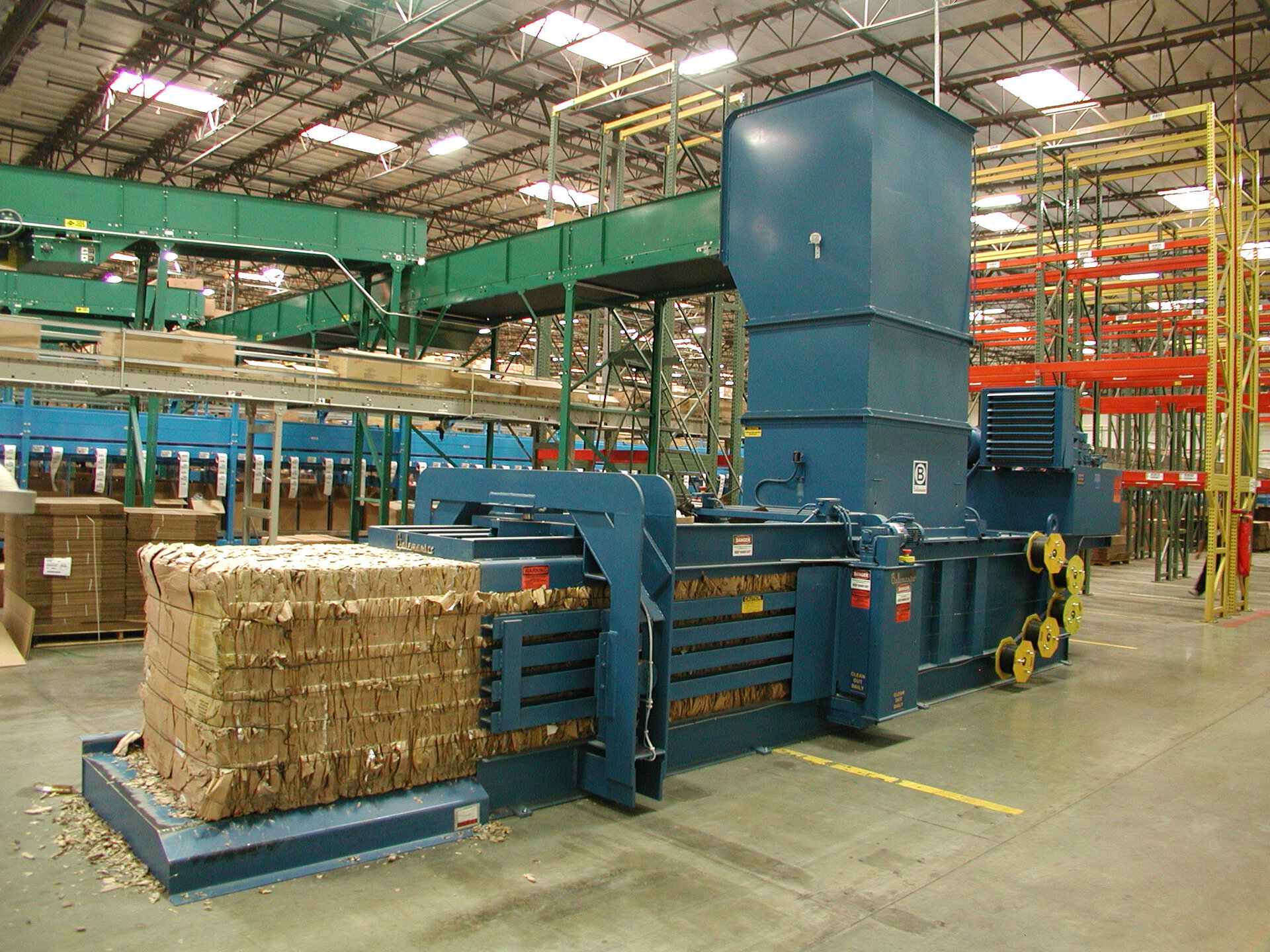
The Two Waste Streams Every DC Deals With
OCC — old corrugated containers
Cardboard is the dominant waste stream at virtually every distribution center. Incoming product arrives in corrugated boxes. Outbound orders are packed in corrugated boxes. The result is a continuous, predictable flow of OCC that accumulates on the receiving dock, the packing floor, and in every corner of the facility if it is not managed actively.
OCC is valuable. At current market prices, baled OCC is a commodity that recyclers will pay to collect. Most DCs without a baler are already having their cardboard hauled away at no cost - but receiving nothing in return. A baler converts that same material into a commodity revenue stream. At most DCs generating meaningful cardboard volume, that revenue closes the cost of a baler within 12 to 36 months.
Plastic film and stretch wrap
The second major waste stream at most DCs is plastic film - stretch wrap from pallets, poly bags from product packaging, and other film plastics that arrive with inbound freight. Film is lighter than OCC and lower in commodity value, but it takes up significant space and creates real disposal cost if it is not baled and sold.
Vertical balers and horizontal full-eject manual-tie balers are the most practical choices for film in a DC environment. If your operation generates both OCC and significant film volume, the right equipment plan may involve two machines - one for each stream - or a two-ram baler that can handle both with one machine.
OCC and plastic film are both recyclable commodities that have market value when baled. The difference is that OCC at volume is a strong commodity play - baled OCC generates consistent, meaningful revenue. Film plastic is lower value per ton but worth baling rather than landfilling or paying to haul loose. Plan for both streams when you are spec-ing equipment.
Which Machine Fits Which DC
The most important variable in equipment selection is your daily OCC volume. Everything else - machine type, automation level, conveyor infeed - follows from that number. Here is how HMS thinks about it.
Vertical baler
At low daily volumes, a vertical baler is typically the right starting point. Compact footprint, low upfront cost, simple operation, and minimal floor space requirements make it practical for smaller DCs, satellite locations, or facilities where cardboard volume is secondary to other operations. Vertical balers produce bales that are manually tied - no auto-tie cycle - which is manageable at low volume but becomes a labor bottleneck as volume increases. Also the right choice for plastic film at this volume tier.
Horizontal manual-tie baler
As OCC volume grows past what a vertical baler handles efficiently, the horizontal manual-tie baler is the natural step up. Larger bale chamber, better throughput, and horizontal compression produce denser, heavier bales than a vertical machine - which improves commodity value and reduces pickup frequency. The manual-tie requirement means an operator ties each bale by hand, which is practical at this volume but becomes costly in labor as throughput increases. Refurbished horizontal manual-tie balers from HMS typically run $65,000 to $90,000 - a strong value for operations in this volume tier.
Horizontal auto-tie baler
The horizontal auto-tie baler is the most common piece of equipment at mid-to-large distribution centers - and for good reason. The auto-tie cycle eliminates the labor of tying bales by hand, continuous feed design allows one operator to manage high material volumes, and with conveyor infeed the machine can run at or near its rated capacity with minimal hands-on involvement. For consistent OCC streams at 5 or more tons per day, this is the machine that delivers the best combination of throughput, labor efficiency, and bale quality. New auto-tie balers from HMS range from $150,000 to $300,000; refurbished units run $95,000 to $125,000.
Two-ram baler
Some distribution centers run a two-ram baler not because they need more throughput than a horizontal auto-tie provides - the two machines are often comparable in OCC capacity - but because they need flexibility. Two-ram balers handle oversized boxes that will not fit a standard horizontal hopper, process multiple material types including OCC and plastic film through one machine, and allow operations to switch between commodities without retooling. If your DC regularly receives large-format product packaging or processes mixed material streams alongside standard OCC, the two-ram's flexibility may justify the higher cost even at moderate daily volumes.
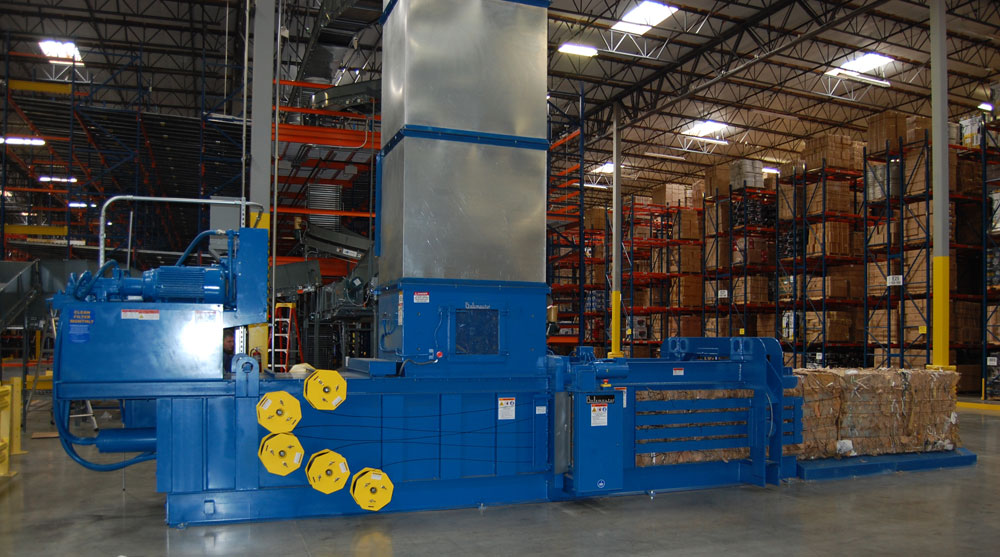
Baler vs. Compactor: The Financial Case
Most distribution centers without a dedicated baler run two compactors - one for trash and one for cardboard. The cardboard compactor typically gets picked up by a recycler at no cost to the DC. Free pickup sounds fine until you realize what you are actually giving away.
A recycling compactor hauls your OCC away for nothing - which means you receive nothing for it. The cardboard your operation generates every single day has real commodity value when baled. A baler converts that material into dense, tied OCC bales that a recycler will pay you to collect. The shift is not from paying for hauling to paying nothing. It is from receiving nothing to receiving a commodity check - and that difference adds up quickly at meaningful daily volumes.
Free pickup - zero revenue
Your cardboard recycling compactor gets emptied at no cost - but you receive nothing for the OCC. The material leaving your dock has real commodity value, but loose or compacted OCC mixed with other waste is difficult for recyclers to process cleanly. You are exchanging a valuable commodity for a pickup arrangement that generates zero return for your operation.
Recyclers pay you for clean OCC bales
A baler produces clean, dense, tied OCC bales that recyclers pay to collect. Your cardboard becomes a commodity revenue stream instead of a zero-value exchange. Pickup frequency drops because baled material is far denser than compacted waste. With conveyor infeed, labor cost per ton drops significantly. The machine pays for itself through new commodity revenue and labor savings.
The math varies by operation and OCC market conditions, but here is a representative example. A DC generating 10 tons of OCC per day currently receiving nothing for it. At $80 to $120 per ton in OCC commodity revenue, baled OCC from that same volume could generate $290,000 to $440,000 annually - revenue the compactor arrangement leaves entirely on the table. Even at smaller volumes, the payback period on a horizontal auto-tie baler installation is typically 12 to 36 months when commodity revenue and labor savings are both factored in.
The question is not whether your cardboard is being hauled away. It is whether you are getting paid for it. Most DCs with a recycling compactor are giving away a commodity asset every day. A baler converts that same material into a revenue stream - and at 3 or more tons of OCC per day, the numbers almost always make the investment worthwhile.
Conveyor Infeed: The Other Half of the System
A horizontal auto-tie baler without conveyor infeed is running at a fraction of its potential. Material still has to get from the receiving dock or packing floor to the baler hopper - and if that happens by hand or by fork truck, you are paying for it in labor every shift.
A properly designed conveyor infeed system solves this by moving material continuously from dock to baler hopper at a consistent rate. The benefits compound: one operator manages significantly more volume per shift, the baler receives a steady material head that improves bale density, and fork truck traffic in the baler area is eliminated or reduced.
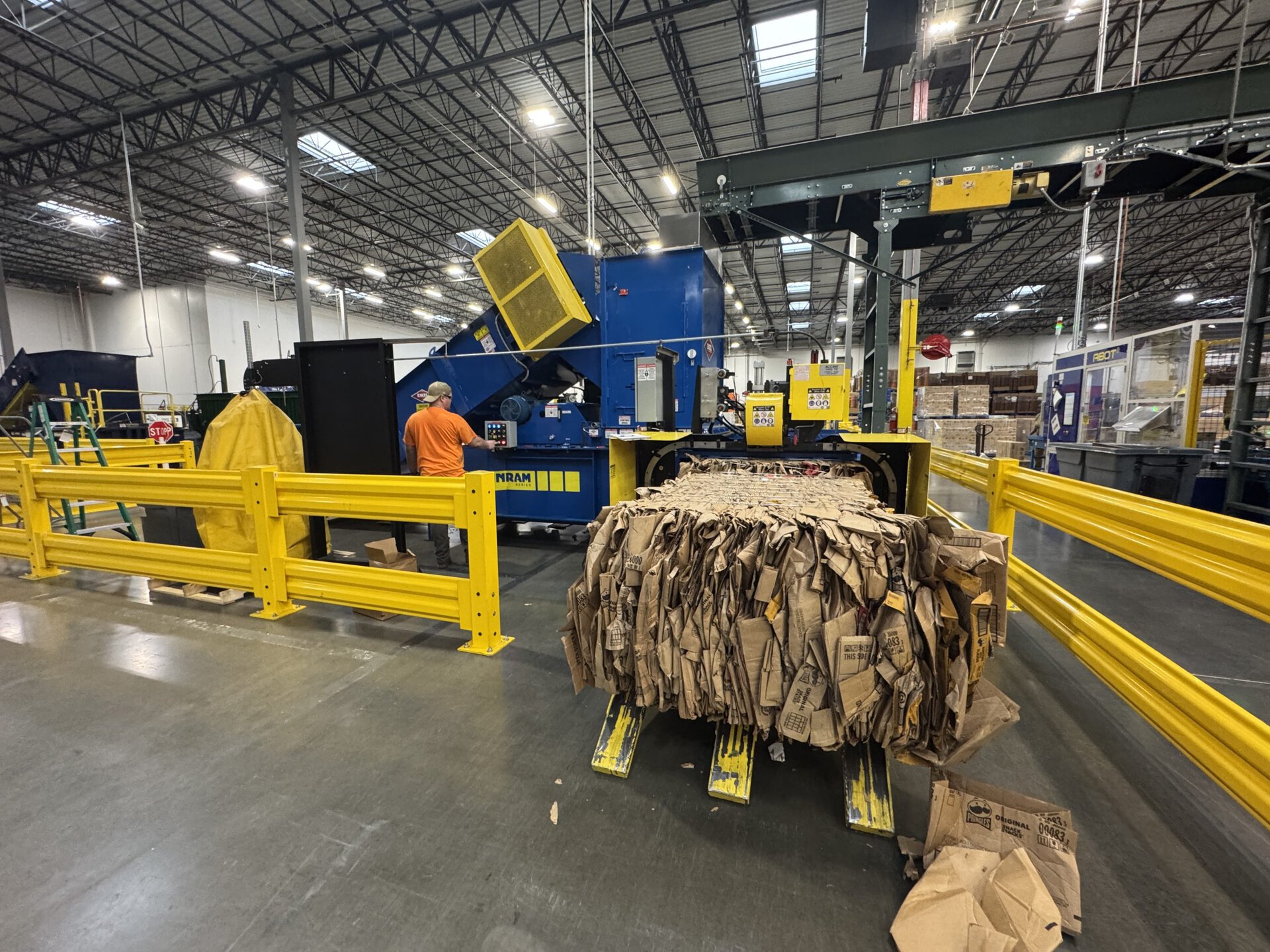
For DC installations, HMS most commonly installs slider bed with cleat conveyors for OCC infeed - either above-ground on a structural frame or recessed in-ground depending on the facility layout. Every conveyor system HMS installs is custom-designed to the specific baler model, floor plan, and material volume. For more on conveyor types, costs, and installation options, see our guide: Baler Infeed Conveyor: What It Does, What It Costs, and Whether You Need One.
What a Full DC Recycling System Looks Like
For most mid-to-large distribution centers, the optimal recycling setup involves more than one piece of equipment. Here is a typical full system HMS installs for a DC operation:
| Component | Purpose | Common choice |
|---|---|---|
| Primary baler | Process OCC from receiving and packing | Horizontal auto-tie baler (Balemaster EO-Series for high volume) |
| Conveyor infeed | Move OCC from dock to baler continuously | Slider bed with cleat, above- or in-ground |
| Film baler | Process stretch wrap and poly film separately | Vertical baler or horizontal full-eject manual-tie baler |
| Two-ram baler (optional) | Handle oversized boxes or multiple material types with one machine | Sized to volume and hopper requirements |
Not every DC needs every component. A smaller operation might run a single horizontal auto-tie for OCC and a small vertical baler for film. A large fulfillment center might run a full auto-tie system with conveyor infeed for OCC and a two-ram for oversized packaging and mixed streams. HMS assesses your specific operation and recommends only what the volume and workflow actually justify.
What a DC Baler Installation Costs
Here is a realistic cost range for each tier of DC baling equipment from HMS - covering the machine, delivery, and installation by our own team.
| Equipment | New | HMS Refurbished | Best for |
|---|---|---|---|
| Vertical baler | $10,000 - $30,000 | $8,000 - $20,000 | Under 2 tons/day, film baling |
| Horizontal manual-tie | $120,000 - $180,000 | $65,000 - $90,000 | 3 to 5 tons/day OCC |
| Horizontal auto-tie | $150,000 - $300,000 | $95,000 - $125,000 | 5+ tons/day OCC with conveyor infeed |
| Two-ram baler | $240,000 - $400,000+ | $125,000 - $400,000 | Oversized material, mixed streams |
| Conveyor infeed system | $30,000 - $80,000 | $20,000 - $60,000 | Any baler installation at 3+ tons/day |
Financing available - approvals in as little as 24 hours
HMS works with equipment lenders for qualified buyers on new and refurbished baler and conveyor purchases. New equipment qualifies for Section 179 tax deduction in the year of purchase - which can significantly improve first-year payback calculations. Ask about current financing options when you request a quote.
Call (219) 733-2108 or contact us online to get started.
Frequently Asked Questions
The right baler depends on your daily OCC volume. Under 2 tons per day: vertical baler. 3 to 5 tons per day: horizontal manual-tie baler. 5 or more tons per day: horizontal auto-tie baler with conveyor infeed. Some DCs also run two-ram balers for their flexibility to handle oversized boxes or multiple material types with one machine - not necessarily because they need more throughput than a horizontal auto-tie provides.
A baler is almost always the better financial choice for OCC at any meaningful volume. A compactor compresses waste into a container that is hauled for a fee - you pay every time. A baler produces commodity bales that recyclers will pay you to collect. At current OCC market prices, the revenue difference plus eliminated hauling fees creates a payback period of 12 to 36 months for most DC baler installations. If you are generating 3 or more tons of OCC per day, the numbers almost always favor a baler.
Plastic film requires different equipment than OCC. Vertical balers and horizontal full-eject manual-tie balers are the most common choices for film in a DC environment. Standard horizontal auto-tie balers are not well suited to film - it can wrap around components and cause jams. If your DC generates both OCC and significant film volume, HMS can help you spec either a two-machine solution or identify the right single machine for your volume mix.
Vertical balers start around $10,000 to $30,000 new. Refurbished horizontal manual-tie balers from HMS typically run $65,000 to $90,000. Refurbished horizontal auto-tie balers run $95,000 to $125,000. New horizontal auto-tie balers range from $150,000 to $300,000. Two-ram balers start at $125,000 refurbished and go higher depending on configuration. Conveyor infeed systems run $80,000 to $115,000 refurbished and $150,000 to $275,000 new.
Bottom Line
The cardboard leaving your dock every day is either an expense or a revenue stream
Every DC is already dealing with OCC and film. The only question is whether it is being managed in a way that costs money or generates it. A properly spec-ed baler - matched to your daily volume, paired with a conveyor infeed if your throughput justifies it, and sized for your material mix - turns the waste your operation generates every shift into a commodity revenue stream and eliminates the hauling cost that comes with a compactor or loose cardboard pickup.
HMS installs complete baler and conveyor systems for distribution centers across Indiana, Tennessee, and North America. We sell new and refurbished equipment, handle installation with our own team, and service the system after the sale. Call us and we will size the right system for your volume.
Tell us your daily OCC volume and floor layout - we will recommend the right equipment and give you a straight quote.