Corrugated cardboard is the most baled material in North America. Box plants, distribution centers, manufacturers, and recycling facilities all generate it, and all of them face the same question: which corrugated baler is right for the volume we produce? The answer is not one machine. It depends on how much OCC you generate, how much labor you want to spend tying bales, and what bale weight your mill or buyer expects. This guide walks through all of it.
HMS is an authorized Balemaster dealer and sells new corrugated balers alongside refurbished machines from all major brands. We have placed corrugated baling equipment in box plants, distribution centers, and recycling facilities across Indiana, Tennessee, and North America - and this guide reflects what we have learned about matching the right machine to the right operation.
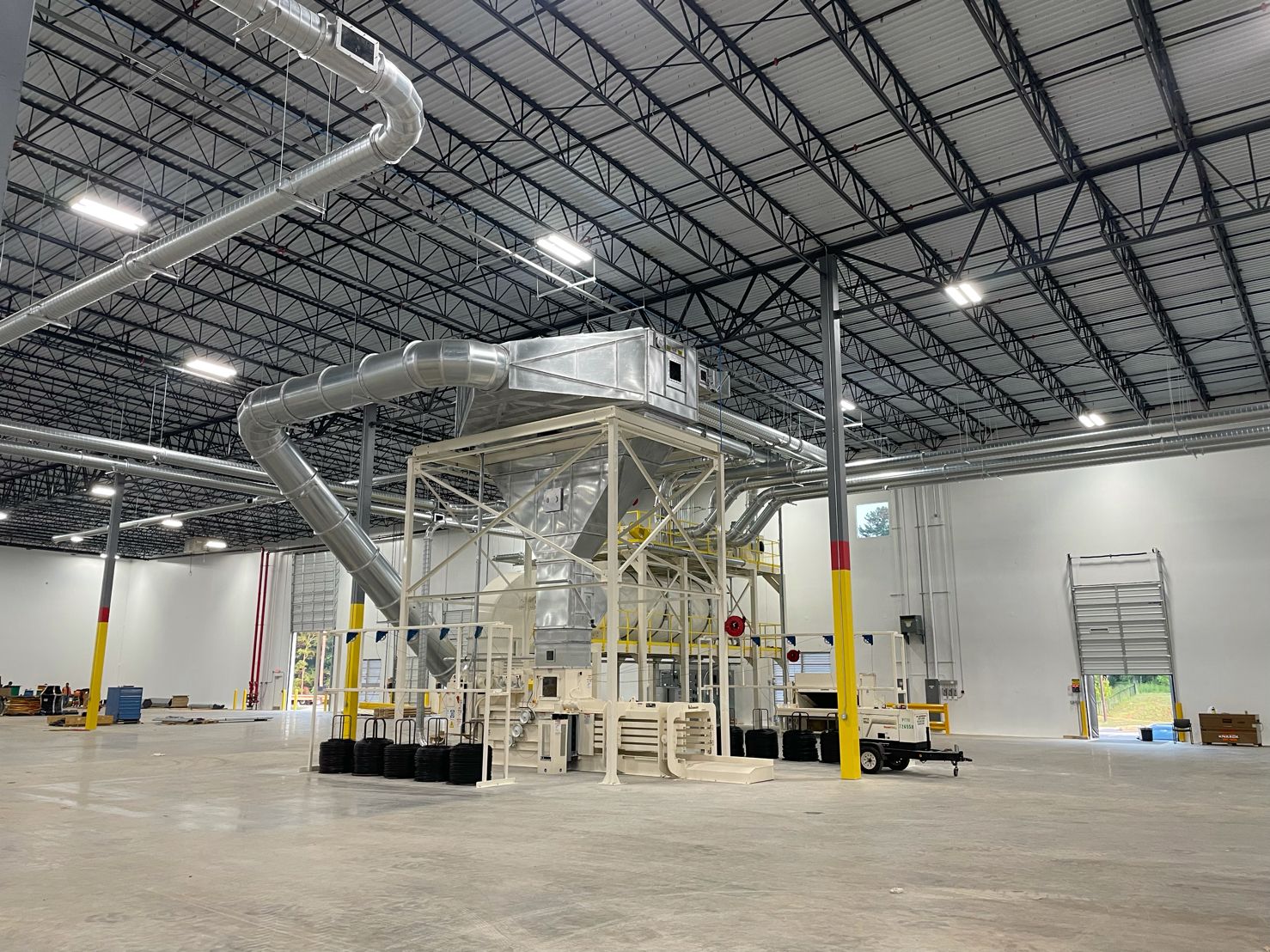
Why Corrugated Is Worth Baling
Corrugated cardboard is a valuable commodity. OCC has a consistent market and mills pay for clean, dense, properly baled material. For any operation generating meaningful corrugated volume, baling that material rather than compacting it or hauling it loose turns a waste-handling cost into a revenue stream.
The financial case is straightforward: a corrugated baler produces mill-ready OCC bales that recyclers and mills pay to collect. The denser and more consistent those bales are, the more revenue you generate per ton and the fewer pickups you need. For box plants and distribution centers in particular - where OCC is generated continuously throughout every shift - the right corrugated baler pays for itself through commodity revenue and reduced handling costs.
Corrugated is one of the few waste streams that is genuinely a revenue opportunity rather than a disposal problem. The question for most operations is not whether to bale OCC - it is which machine produces the bale weight and throughput that matches their volume and their mill's requirements.
Which Corrugated Baler Fits Your Volume
The single most important factor in choosing a corrugated baler is your OCC volume. Here is how HMS thinks about matching machine type to volume - with the understanding that these are guidelines, not hard rules. Labor availability, floor space, and bale weight requirements all factor in.
Horizontal closed-door baler
For operations generating lower corrugated volumes - roughly under 40 to 50 tons per month - a horizontal closed-door baler is often the most cost-effective choice. These machines produce solid, mill-acceptable OCC bales at a lower price point than a full auto-tie system. The tradeoff is that bales are tied manually rather than automatically, which requires operator labor per bale. For lower volumes, that labor is manageable. This is a strong value option for smaller distribution centers, regional facilities, and operations where corrugated is a steady but moderate stream.
Horizontal auto-tie baler
Above roughly 40 to 50 tons per month, the horizontal auto-tie baler becomes the better fit for most operations. The automatic tie cycle eliminates the labor of hand-tying every bale, which matters more and more as volume climbs. With continuous feed and conveyor infeed, an auto-tie machine lets one operator manage high OCC volumes efficiently while producing consistent, dense, mill-ready bales. This is the most common corrugated baler at box plants, mid-to-large distribution centers, and recycling facilities.
Auto-tie at lower volumes
The volume threshold above is not a hard rule. Plenty of operations choose a horizontal auto-tie baler even at lower corrugated volumes - specifically because of the labor savings. If hand-tying bales pulls an operator away from other work, or if labor is tight, the automatic tie cycle can justify the higher machine cost even below 40 to 50 tons per month. The right answer depends on what an hour of operator labor is worth in your operation. HMS helps buyers run that comparison honestly.
Two-ram baler
Some operations process corrugated alongside oversized boxes, mixed materials, or other commodities. A two-ram baler offers the flexibility to handle oversized cardboard that will not fit a standard horizontal hopper and to switch between material types with one machine. Two-rams are not necessarily higher capacity than a horizontal auto-tie for straight OCC - they are about flexibility. If your corrugated stream includes large-format packaging or you need one machine to handle multiple materials, a two-ram may be worth the higher cost.
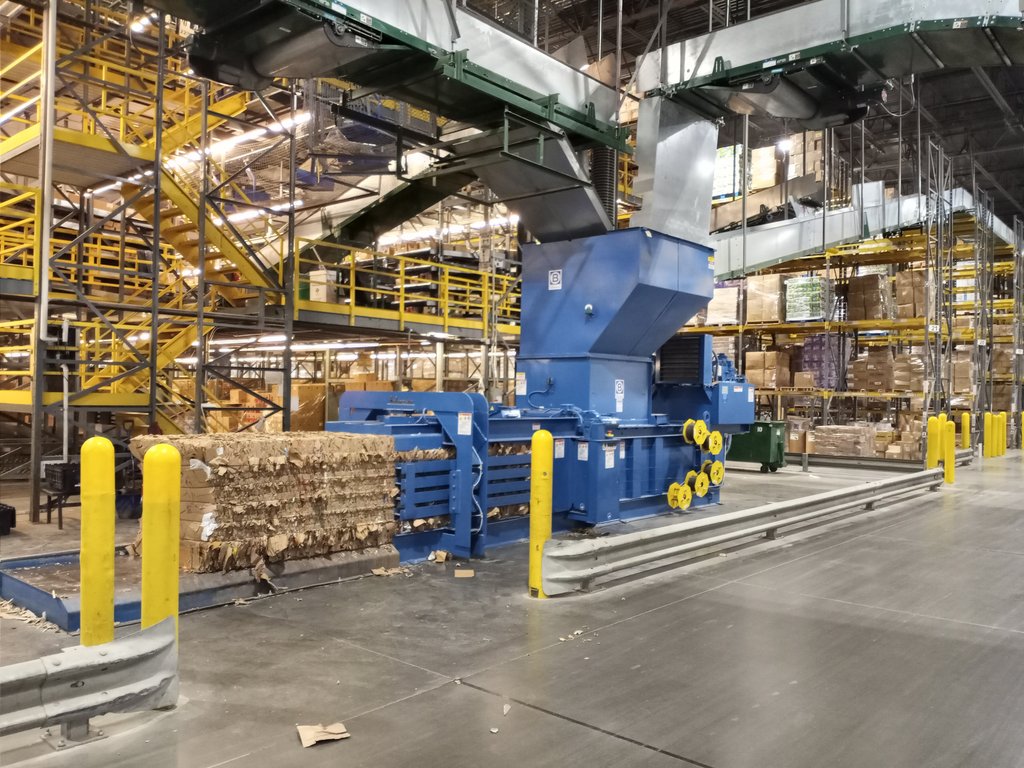
Balemaster Corrugated Balers: E-Series and EO-Series
HMS is an authorized Balemaster dealer. Balemaster - based in Crown Point, Indiana, about 30 miles from our Wanatah facility - builds horizontal auto-tie balers that are widely regarded as a benchmark for corrugated baling. Two product lines cover the full range of OCC volumes.
The E-Series produces a 30-inch wide bale and is built for printers, box plants, paper converters, and moderate-volume corrugated operations. Horsepower ranges from 20HP to 150HP with 6-inch, 8-inch, or 10-inch cylinder options. On corrugated specifically, E-Series machines produce bale weights in the range of 1,100 to 1,700 pounds depending on model and bale length, at densities of roughly 25 to 32 pounds per cubic foot. The model number encodes throughput - adding a zero gives cubic feet per hour of dry capacity, so an E-980 moves 9,800 cubic feet per hour. For operations where corrugated volume is steady but not extreme, the E-Series delivers mill-quality bales in a manageable footprint.
The EO-Series uses an oversized hopper and produces larger bales - up to 48 inches wide by 40 inches tall - making it the choice for high-volume corrugated operations. Feed chutes run up to 75 inches long, enabling material infeed at high volumes, and cylinder options run from 8 inches up to 12 inches for maximum bale density. EO-Series machines produce heavier corrugated bales than the E-Series - the higher ram thrust and larger bale chamber generate the dense, mill-spec OCC bales that maximize freight economics. Within the EO line, the 5200 Series is built specifically for large, high-density corrugated bales where capacity is the primary driver. For box plants and distribution centers generating high continuous OCC volume, the EO-Series is the workhorse.
Balemaster's model number system makes capacity easy to compare: add a zero to the model number to get cubic feet per hour of dry throughput. An EO-1760 moves roughly 17,600 cubic feet per hour at no load. When you are comparing models for a corrugated application, this gives you a quick way to match machine throughput to your OCC volume.
Why Corrugated Bale Weight and Density Matter
For corrugated, bale weight is not just a spec - it is money. Here is why it matters more than buyers often realize:
- Freight economics. A truckload holds a fixed number of bales. Heavier, denser bales mean more OCC per truckload - which means more revenue per shipment and fewer pickups for the same tonnage. Light bales waste truck space and money.
- Mill acceptance and pricing. Mills have minimum density and quality standards for OCC. Consistent, dense, well-formed bales meet spec reliably and command better pricing. Loose or inconsistent bales can be downgraded or rejected.
- Storage and handling. Denser bales take up less floor space per ton and are more stable to stack and store while you accumulate a full load.
This is why the machine you choose matters beyond just throughput. A baler that produces consistent, dense, mill-spec corrugated bales generates more revenue per ton than one producing light or loosely formed bales - even at the same volume. The ram thrust, bale chamber design, and density controls on a quality corrugated baler are what produce that result.
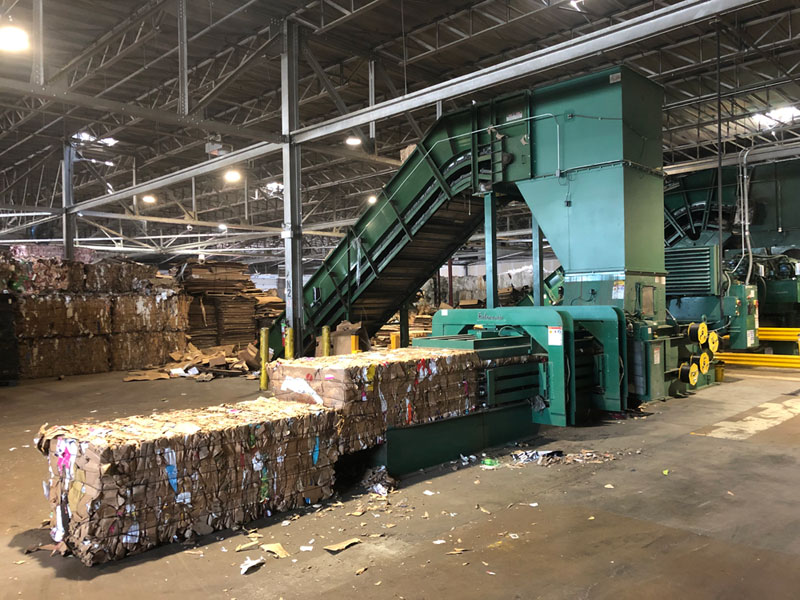
Who Buys Corrugated Balers
Corrugated balers serve a wide range of operations, each with slightly different priorities:
- Box plants and corrugated sheet plants - generate consistent, high-volume OCC trim and broke. Predictable material makes these ideal for high-throughput auto-tie systems. The E-Series and EO-Series both serve this market depending on volume.
- Distribution centers and warehouses - generate continuous OCC from inbound and outbound packaging. Most mid-to-large DCs run horizontal auto-tie balers; smaller DCs may run closed-door or manual-tie machines.
- Printers and paper converters - generate corrugated alongside paper trim. The E-Series is particularly well suited to this mixed printer environment.
- Recycling facilities and MRFs - process OCC as a primary commodity. High-volume operations run EO-Series or two-ram machines to handle the throughput.
- Retailers and grocery operations - generate steady corrugated from product packaging. Volume determines whether a vertical, closed-door, or auto-tie machine fits best.
What a Corrugated Baler Costs
| Machine type | New | HMS Refurbished | Best for |
|---|---|---|---|
| Vertical baler | $15,000 - $40,000 | $8,000 - $20,000 | Very low corrugated volume |
| Horizontal closed-door / manual-tie | $100,000 - $180,000 | $50,000 - $90,000 | Under 40-50 tons/month |
| Horizontal auto-tie | $185,000 - $300,000 | $95,000 - $125,000 | 40-50+ tons/month OCC |
| Two-ram baler | $240,000 - $400,000+ | $125,000 - $400,000 | Oversized or mixed material |
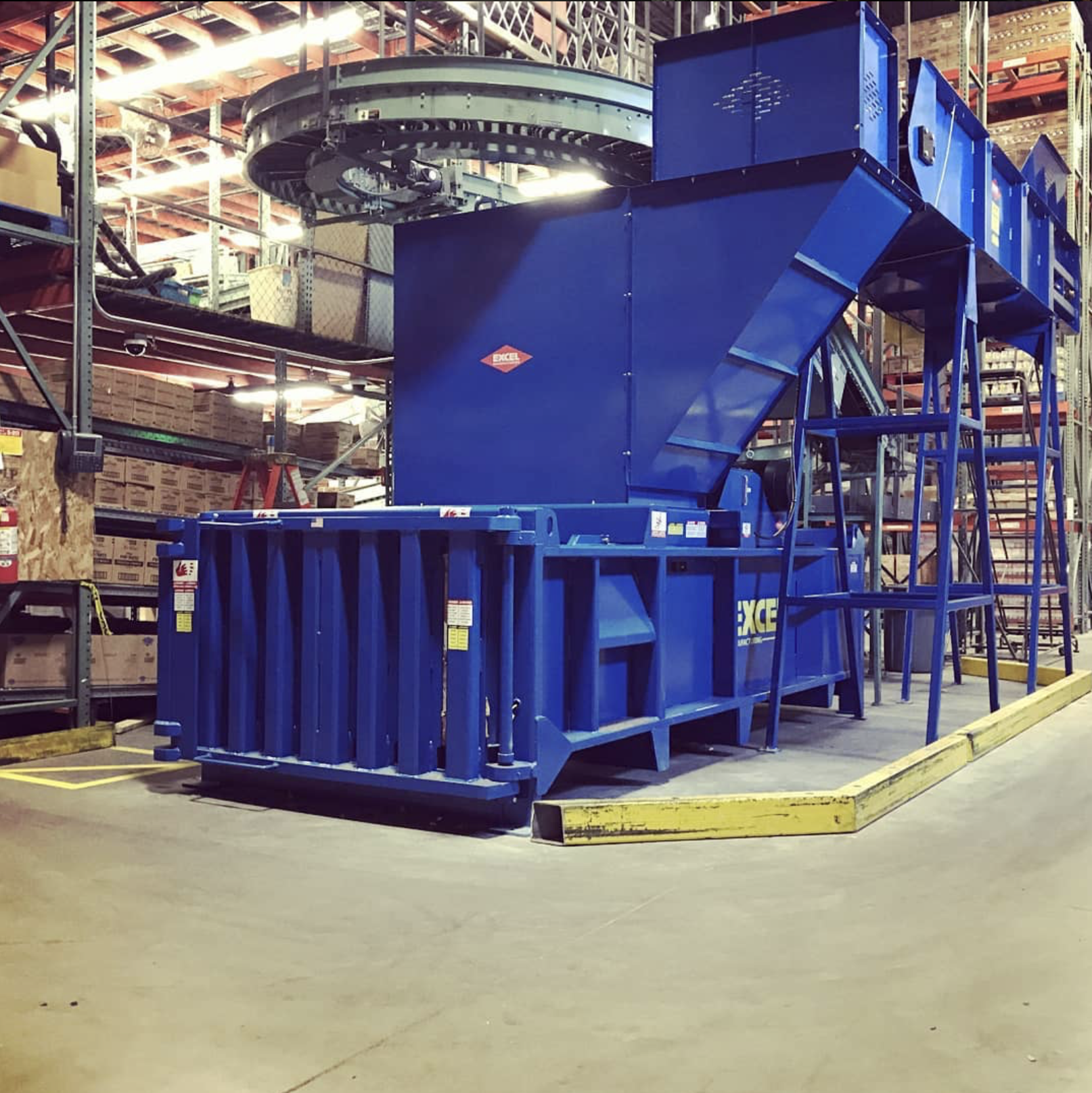
Financing available - approvals in as little as 24 hours
HMS works with equipment lenders for qualified buyers on new and refurbished corrugated balers. New equipment qualifies for Section 179 tax deduction in the year of purchase - which can significantly improve first-year payback calculations on a corrugated baling investment.
Call (219) 733-2108 or contact us online to get a quote on the right corrugated baler for your volume.
Frequently Asked Questions
The best corrugated baler depends on your volume. For operations generating under roughly 40 to 50 tons of OCC per month, a horizontal closed-door baler is often the most cost-effective choice. Above that volume, a horizontal auto-tie baler is typically the better fit because the automatic tie cycle eliminates the labor of hand-tying bales. Some operations choose an auto-tie even at lower volumes specifically for the labor savings. Two-ram balers are used when oversized boxes or mixed material flexibility is needed. HMS is an authorized Balemaster dealer and helps buyers match the right machine to their volume.
Corrugated baler costs vary by type. New horizontal auto-tie balers range from $185,000 to $300,000. Refurbished horizontal auto-tie balers from HMS run $95,000 to $125,000. Refurbished horizontal manual-tie and closed-door balers run $65,000 to $90,000. Vertical balers for very low volume start around $15,000 to $30,000. HMS sells new Balemaster corrugated balers and refurbishes machines from all major brands at our Wanatah, Indiana facility.
Corrugated bale weight and density directly affect your commodity revenue and freight economics. Heavier, denser bales mean more material per bale and per truckload, which reduces the number of pickups and maximizes the value of each shipment to the mill. Mills also have minimum bale density and quality standards. A baler that produces consistent, dense, mill-spec OCC bales generates more revenue per ton than one producing light or loosely formed bales.
Balemaster offers two main horizontal auto-tie lines well suited to corrugated. The E-Series produces a narrower 30-inch bale and fits printers, box plants, and moderate-volume operations. The EO-Series uses an oversized hopper for larger bales and higher volumes, making it ideal for high-volume distribution centers, box plants, and MRFs. The 5200 Series within the EO line is specifically built for large, high-density corrugated bales. HMS is an authorized Balemaster dealer and can spec the right model for your corrugated volume.
Bottom Line
Match the machine to your volume, your labor, and your mill
The right corrugated baler is the one that matches your OCC volume, your labor situation, and the bale weight your mill expects. Under 40 to 50 tons per month, a horizontal closed-door baler is often the most cost-effective option. Above that, a horizontal auto-tie - and the labor savings can justify an auto-tie even at lower volumes. For oversized or mixed material, a two-ram adds flexibility. And whichever machine fits, bale weight and density are what turn your corrugated stream into maximum commodity revenue.
HMS is an authorized Balemaster dealer carrying the E-Series and EO-Series for corrugated, plus refurbished machines from all major brands. We handle delivery, installation, and service with our own team. Call us and we will help you spec the right corrugated baler for your operation.
Tell us your monthly OCC volume and we will recommend the right corrugated baler and give you a straight quote.