The vertical baler is where baling starts. It is the lowest-cost machine in the recycling equipment world, it fits through a standard dock area into the back corner of almost any building, and it turns loose cardboard, film, and containers into dense, sellable bales. For operations generating up to roughly 2 tons of material per day, it is usually the right machine - and this guide covers everything a first-time or replacement buyer needs: what it costs, what it bales, how the 60-inch and 72-inch sizes compare, and the honest signs you have outgrown one.
HMS sells new vertical balers from Marathon and PTR, and refurbishes vertical balers from major brands in-house at our Wanatah, Indiana facility. We install and service everything we sell across Indiana, Tennessee, and North America.
How a Vertical Baler Works
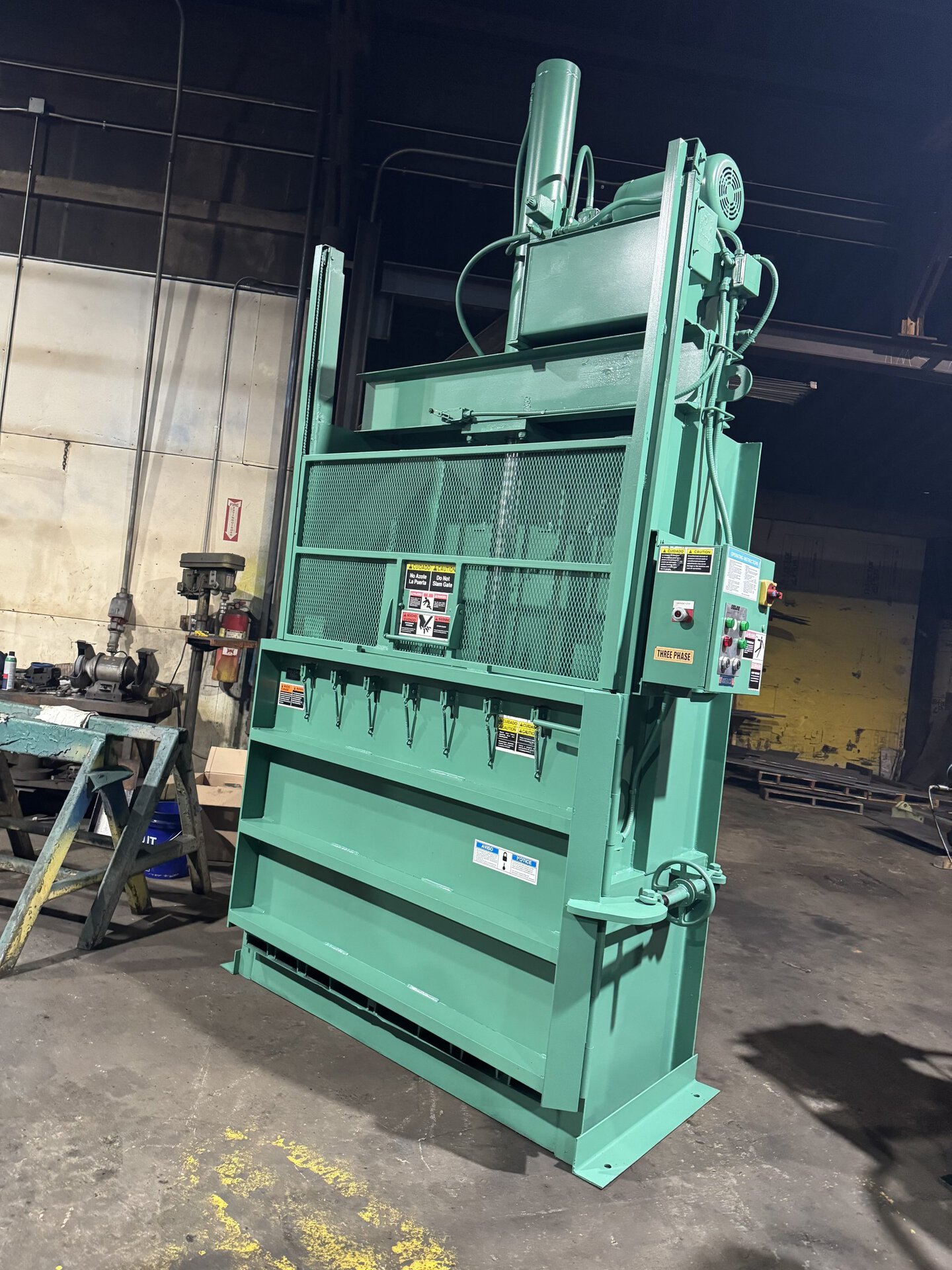
A vertical baler is a downstroke machine. The operator loads material through a front feed gate into the chamber, closes the gate, and cycles the machine - a hydraulic cylinder drives the platen straight down, compressing the material against the chamber floor. The platen retracts, the operator loads more, and the cycle repeats until the chamber is full and the bale reaches density.
Then the operator ties the bale by hand - threading wire through slots in the chamber, front to back, typically five or six ties per bale. The bale door swings open and a chain-type ejector (manually set on most machines, automatic on some) tips the finished bale out for a pallet jack or fork truck.
Everything about the design trades speed for simplicity and cost. One cylinder, one motor, a straightforward control panel, and a cycle time under a minute. There is no automatic wire tier, no conveyor infeed, no continuous feed - which is exactly why the machine costs a fraction of a horizontal baler and why it stops making sense past a certain daily volume.
A vertical baler is the right machine when baling is a task someone does a few times a day, not a process that runs all shift. If an operator loads it between other duties and ties off two or three bales a day, the vertical's simplicity is all upside. When baling becomes someone's main job, the math starts pointing at a horizontal machine.
What a Vertical Baler Handles
- Cardboard (OCC). The classic application. A 60-inch vertical produces mill-size OCC bales in the 850 to 1,300 pound range depending on model; a 72-inch machine pushes that to 1,200 to 1,800 pounds. Dense, wire-tied vertical bales are accepted by the same recyclers and mills buying horizontal-baled OCC.
- Plastic film and stretch wrap. One of the vertical baler's most important jobs. Film can jam standard horizontal balers, but a vertical handles it well - which is why warehouses and distribution centers often run a vertical for film even when a horizontal machine handles their cardboard.
- Plastics - PET and HDPE. Bottles, containers, and rigid plastics bale cleanly in a vertical at the volumes most operations generate them.
- Non-ferrous metals. Aluminum cans and light non-ferrous material bale well in a vertical at low volumes - a practical option for operations accumulating cans alongside other recyclables.
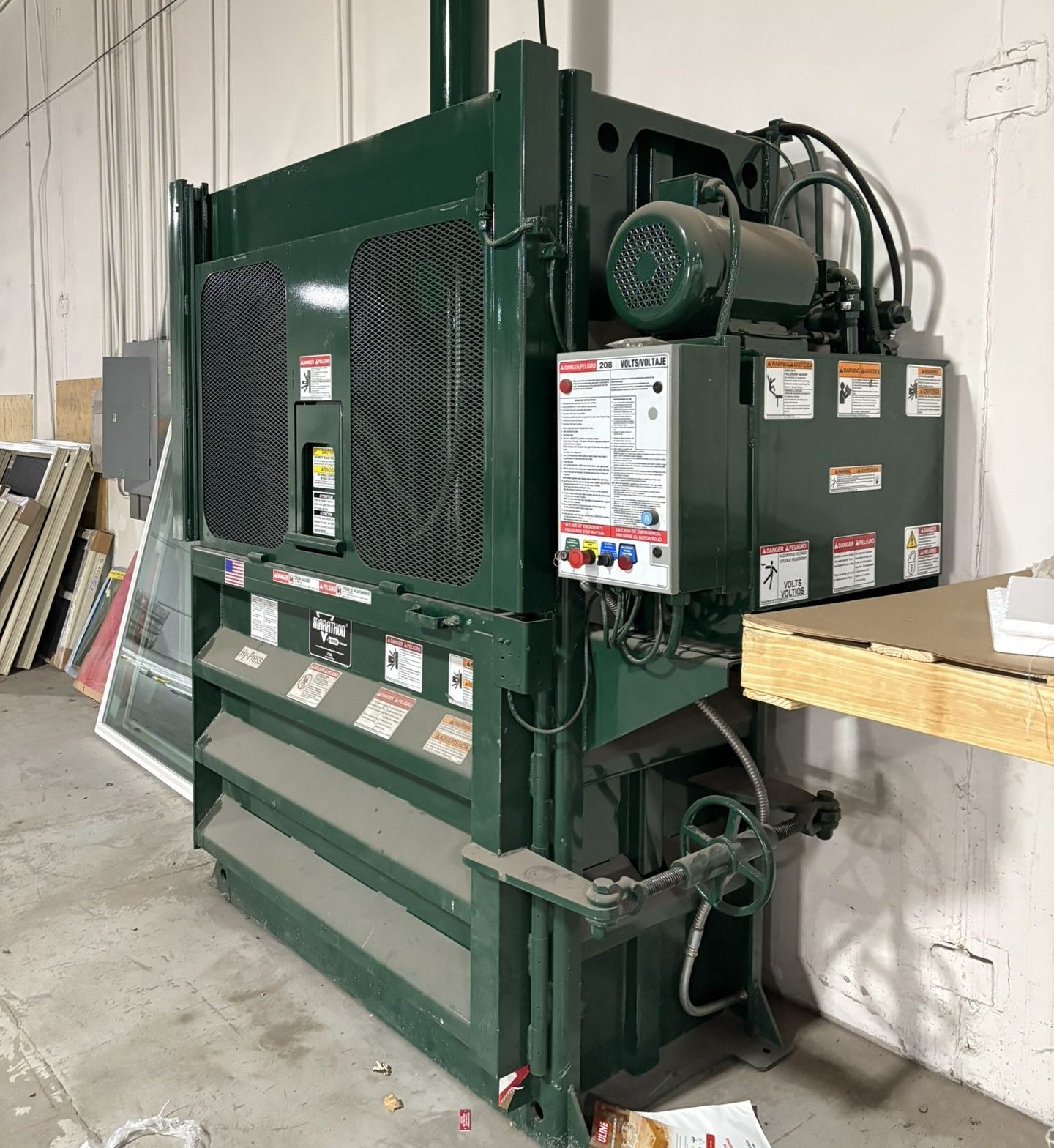
60-Inch vs. 72-Inch: The Size Decision
Vertical balers come in widths from 30 inches up, but HMS typically sells the two sizes that cover the vast majority of real applications: 60-inch and 72-inch machines.
| Factor | 60-inch vertical baler | 72-inch vertical baler |
|---|---|---|
| OCC bale weight | Roughly 850 - 1,300 lbs by model | Roughly 1,200 - 1,800 lbs |
| Feed opening | 60" wide | 72" wide - takes larger boxes unbroken |
| Typical motor | 10 HP | 20 HP class |
| Best for | Retail, grocery, warehouses, small production | Larger boxes, higher volume, heavier bale targets |
The 60-inch machine is the workhorse - it produces a mill-size bale, fits nearly anywhere, and covers most retail, warehouse, and small production applications. The 72-inch machine earns its place when your boxes are large enough that breaking them down to fit a 60-inch opening costs real labor, or when heavier bales meaningfully improve your pickup economics. Neither size is a hard rule; HMS looks at your material, your space, and your volume before recommending one.
The Vertical Balers HMS Sells New
HMS sells new vertical balers from two manufacturers - PTR and Marathon - and both build heavy-duty machines that hold up in daily commercial service.
PTR's most popular 60-inch high-density machine, built with heavy structural steel for warehouses, retail chains, distribution centers, and manufacturing plants. Produces bales up to 1,100 pounds with a 30 x 48 inch chamber and 54-inch feed height that keeps loading manageable.
PTR's flagship signature series - the first high-density vertical baler on the market, with over 10,000 units produced. The step up in platen force over the 2300HD translates directly into heavier, denser bales from the same footprint. A fixture in supermarkets, retail centers, hospitals, hotels, and malls.
The 72-inch answer: a 72 x 28 inch feed opening swallows large-format boxes without breakdown labor, and 100,041 pounds of working platen force produces OCC bales up to 1,800 pounds. When box size or bale weight pushes past what a 60-inch machine does comfortably, this is the machine.
Marathon's HD vertical is built around serviceability: a side-mounted hydraulic power unit with front-opening control panel eliminates the 48-inch side clearance most machines require, a redundant feed-gate interlock system backs up the safety circuit, and the smart relay control adds diagnostics and troubleshooting capability. Options include an automatic bale ejector, front tie-off wire guides so no one goes behind the machine, a Bale Made light, and a lockable disconnect for lockout tagout. Suited to shopping plazas, supermarkets, hospitals, schools, retailers, DCs, and manufacturing plants.
What a Vertical Baler Costs
New vertical baler
New vertical balers from Marathon and PTR fall in this range depending on size, platen force, and options like automatic ejectors and front tie-off systems. Full manufacturer warranty, delivered and installed by HMS. This is the lowest-cost entry into baling equipment by a wide margin - a fraction of any horizontal machine.
HMS refurbished vertical baler
Refurbished vertical balers go through the HMS shop in Wanatah for hydraulic service, cylinder and platen inspection, controls check, and wear component replacement before they ship - backed by the HMS 120-Day Parts & Labor Warranty. For a first baler at a smaller operation, a refurbished vertical is often the best value in the building. Not sure which path fits? Our guide to new vs. used vs. refurbished balers breaks down the decision.
Who Runs Vertical Balers
- Retailers, grocery stores, and supermarkets - steady cardboard from daily deliveries, baled in the back room a few times a day
- Warehouses and smaller distribution centers - OCC below the horizontal threshold, plus a vertical dedicated to plastic film even at larger sites
- Hospitals, hotels, schools, and malls - consistent cardboard and plastics volume without a production-line waste stream
- Small print shops and manufacturers - trim, packaging scrap, and off-spec material at modest daily volume
- Any operation starting to capture commodity revenue - the vertical is how operations stop paying to haul loose material and start selling bales
When You Have Outgrown a Vertical Baler
The honest threshold is about 2 tons of material per day. Below that, the vertical's low cost and simplicity win. Above it, the machine's manual nature starts working against you: the sub-minute cycles add up, hand-tying every bale eats operator time, and baling stops being a between-tasks job and becomes someone's actual job.
Labor is the exception that moves the line. If the operator hours spent loading, cycling, and tying bales are needed elsewhere - or if labor is simply hard to staff - some operations step up to a horizontal machine before they hit 2 tons a day, because the labor savings justify it. That is the same logic that drives auto tie purchases at lower volumes on the horizontal side.
The signs you are there: bales stacking up untied because no one has time, material overflowing while the baler sits full, or an operator spending hours a day at the machine. When that is the picture, the next step is a horizontal baler - our guide to the horizontal auto tie baler covers what that machine does, and HMS can walk you through whether a closed-door, manual tie, or auto tie machine fits your volume.
New Marathon and PTR, or HMS refurbished - both paths covered
HMS sells new vertical balers from Marathon and PTR, refurbishes vertical balers in-house at Wanatah, and installs and services everything we sell. Every HMS refurbished machine is backed by the HMS 120-Day Parts & Labor Warranty.
Call (219) 733-2108 and tell us your material and daily volume - we will recommend the right vertical baler, or tell you honestly if you need more machine.
Frequently Asked Questions
New vertical balers typically run $15,000 to $40,000 depending on size, platen force, and options. Refurbished vertical balers from HMS typically run $8,000 to $20,000 and are rebuilt in-house at our Wanatah, Indiana facility, backed by the HMS 120-Day Parts & Labor Warranty. The vertical baler is the lowest-cost entry point into baling equipment by a wide margin.
Vertical balers handle cardboard (OCC), plastic film and stretch wrap, plastics including PET and HDPE containers, and non-ferrous metals such as aluminum cans. Cardboard is the most common application, and vertical balers are also one of the most practical machines for plastic film - a material that standard horizontal auto tie balers do not handle well.
The 60-inch vertical baler is the standard workhorse - it produces mill-size bales of roughly 850 to 1,300 pounds on OCC depending on the model, and fits most retail, warehouse, and small production applications. The 72-inch vertical baler adds a wider feed opening and heavier bales, roughly 1,200 to 1,800 pounds on OCC, for operations handling larger boxes or more volume. HMS typically sells 60-inch and 72-inch machines, new from Marathon and PTR and refurbished from major brands.
The general threshold is around 2 tons of material per day. Below that, a vertical baler is usually the most cost-effective choice. Above it, the manual cycle time and hand-tying labor of a vertical machine start costing more than the price difference of a horizontal baler. Labor is the exception - some operations upgrade earlier because the operator time spent loading, cycling, and tying bales is needed elsewhere.
Bottom Line
The right first baler - and the honest ceiling
For operations generating up to about 2 tons of material a day, a vertical baler is the right machine: the lowest cost of entry in the equipment world, a footprint that fits almost anywhere, and dense, sellable bales of cardboard, film, plastics, and light non-ferrous. The 60-inch machines from PTR and Marathon cover most applications; the 72-inch PTR steps up for bigger boxes and heavier bales. And when your volume or your labor situation outgrows the machine, that is not a failure of the vertical - it is the machine having done its job while your operation grew.
HMS sells new Marathon and PTR vertical balers, refurbishes verticals in-house with a real warranty behind them, and will tell you straight whether a vertical fits your volume or whether you should be looking at a horizontal machine. Call us and tell us what you generate.
Tell us your material and daily volume - we will recommend the right vertical baler and give you a straight quote.