Manufacturers do not think about scrap the way recyclers do, and they should not have to. In a plant, scrap is a byproduct: corrugated from inbound packaging, stretch film off pallets, banding, trim off the line, off-spec product. It takes up floor space, it eats labor every time someone walks a cart to the dumpster, and it goes out the door as a hauling invoice. The right baler flips that equation. Loose scrap that costs money to haul becomes dense bales that ship efficiently, and commodities like cardboard and non-ferrous trim often stop being a cost at all.
This guide covers the best balers for industrial manufacturers by scrap stream and volume, the same way HMS walks through it with plants across the country: what you generate, how much of it, and how it should reach the machine.
Start With the Scrap Stream, Not the Baler
Every plant's scrap profile is different, but most manufacturing scrap falls into a few buckets:
- Corrugated (OCC). Inbound packaging, cartons, slip sheets. The most common baled commodity in manufacturing, and the one with the most established market. Many plants with steady volume have baled OCC hauled at no cost, and larger volumes generate revenue.
- Stretch film and poly. Pallet wrap, bags, shrink film. Low weight, high volume, and a dumpster-filler if it is not baled. Film bales have a market, but the bigger win is usually hauling reduction.
- Production trim and converting scrap. Paper and corrugated trim, die-cut skeletons, edge trim. Continuous streams that are best fed to the baler automatically rather than handled by people.
- Rigid plastics and off-spec product. Purgings, rejected parts, totes, drums. Tougher material that needs real compression force.
- Non-ferrous metal trim. Aluminum and copper-bearing trim and stampings. High commodity value that justifies dense, clean, sorted bales.
The question that narrows it fastest: how much do you generate, and how varied is it? Volume sets the machine class. Material mix then decides which machine within that class, since closed door horizontals and two rams both run multiple commodities, just in different ways and at different volumes.
Vertical Balers: The Entry Point
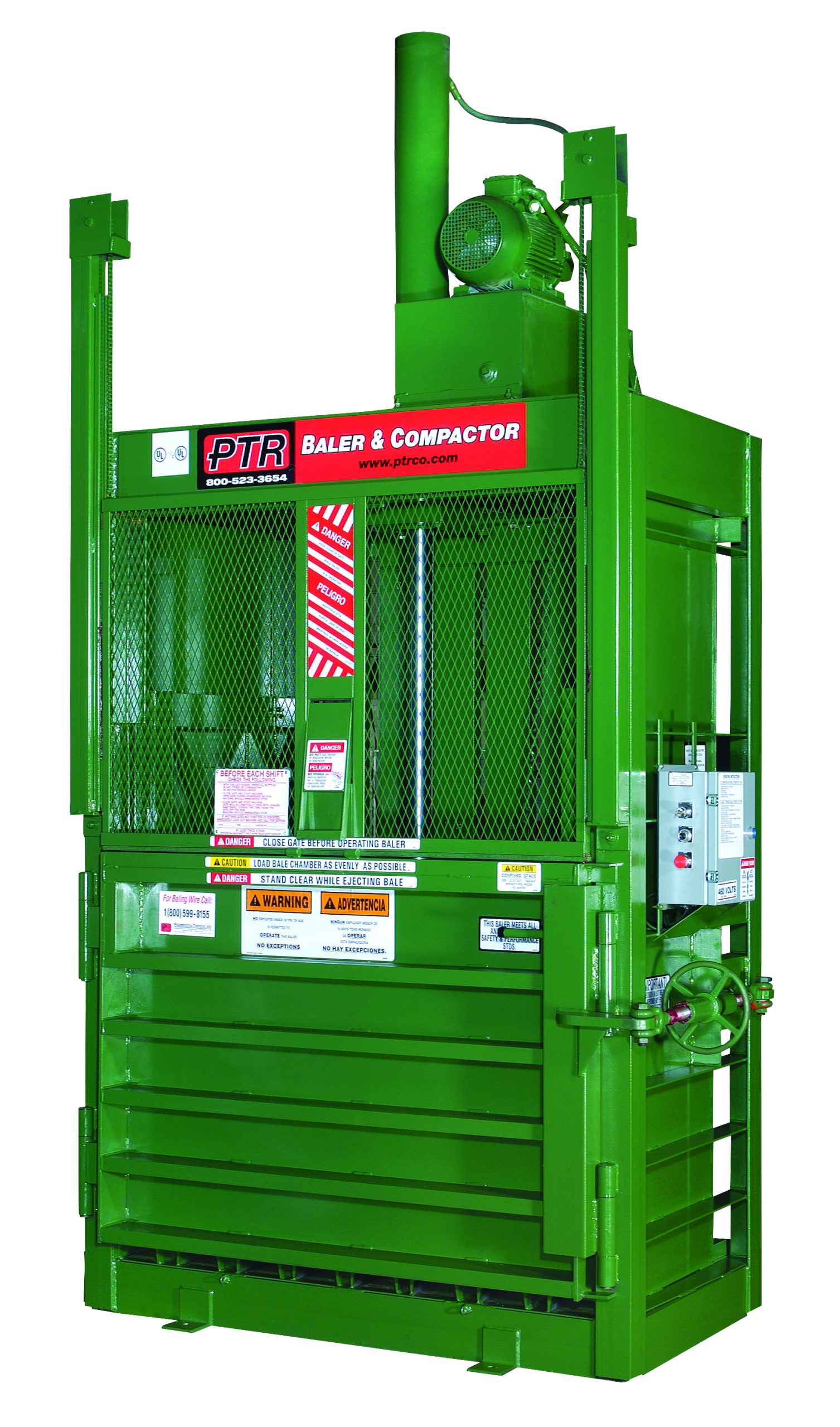
For plants where scrap is light and cardboard is occasional, a vertical baler is the entry point. It is the lowest-cost machine class, fits almost any building on a small footprint, and turns a dumpster problem into stacked bales. The tradeoff is labor: an employee loads it, cycles it, ties bales off by hand, and ejects them. That is fine at low volume and a bottleneck beyond it.
Verticals fit manufacturers generating up to roughly a ton or two of cardboard a day. Past that, the labor per bale starts costing more than the machine saved.
Horizontal Manual-Tie Balers: The 2.5 to 5 Tons Per Day Sweet Spot
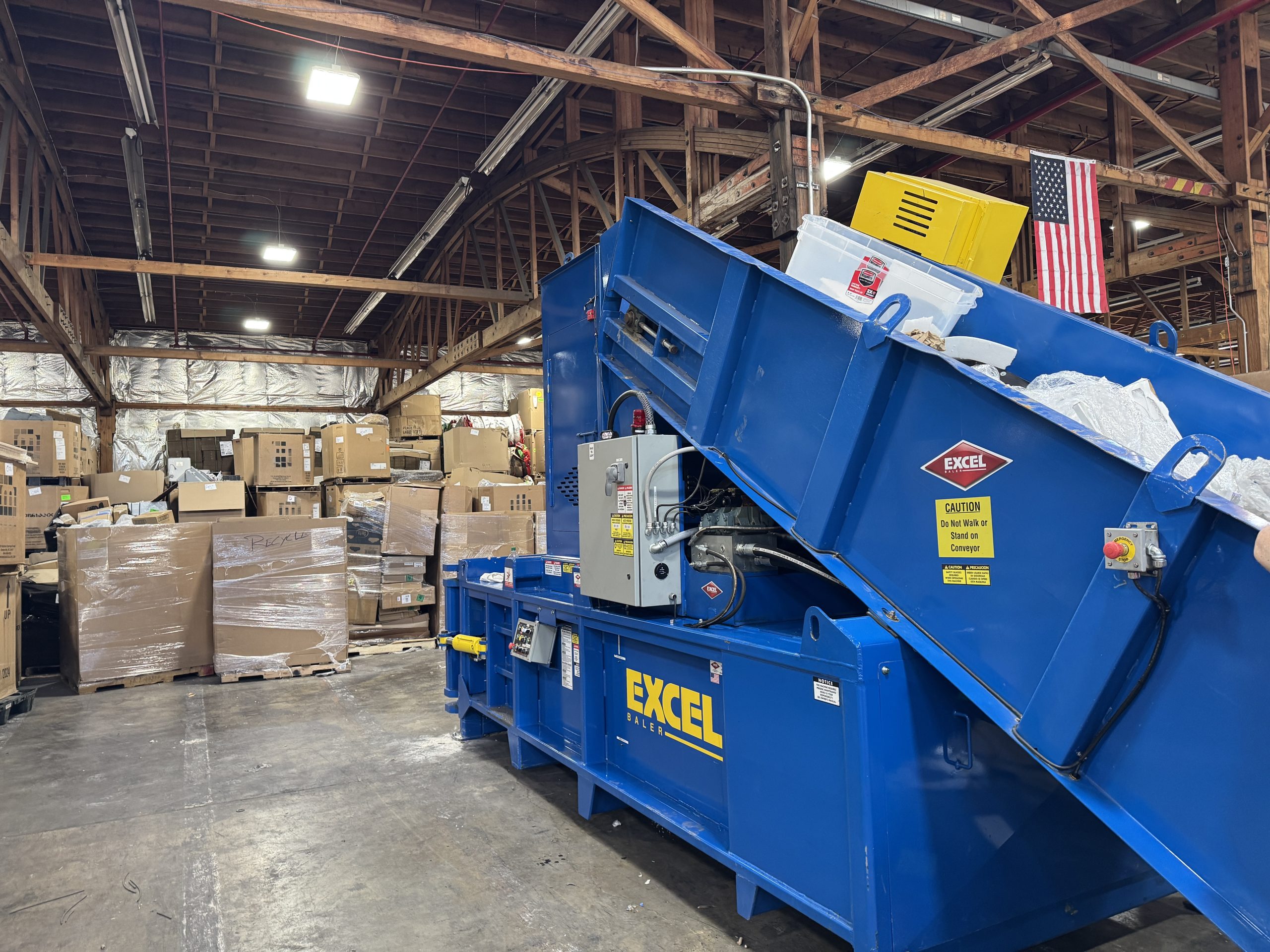
When daily volume reaches roughly 2.5 to 5 tons per day, a horizontal manual-tie baler is usually the right machine. The horizontal format loads from the top, by hand, by forklift, by cart dumper, or by conveyor, and cycles continuously instead of one charge at a time. An operator still ties bales off manually, but the machine does the compaction work at a pace a vertical cannot match, and it accepts conveyor feed, which starts pulling labor out of the process.
Manual-tie horizontals are the workhorse for mid-size plants with steady cardboard and paper volume that does not yet justify automation. They are also a natural first horizontal for plants stepping up from a vertical they have outgrown.
Fiber is not the limit, either. Closed door horizontal balers handle a range of materials, and the full eject models HMS mainly sells do well for plants that need to run both cardboard and plastics on one machine.
Horizontal Auto-Tie Balers: When Volume Justifies Automation
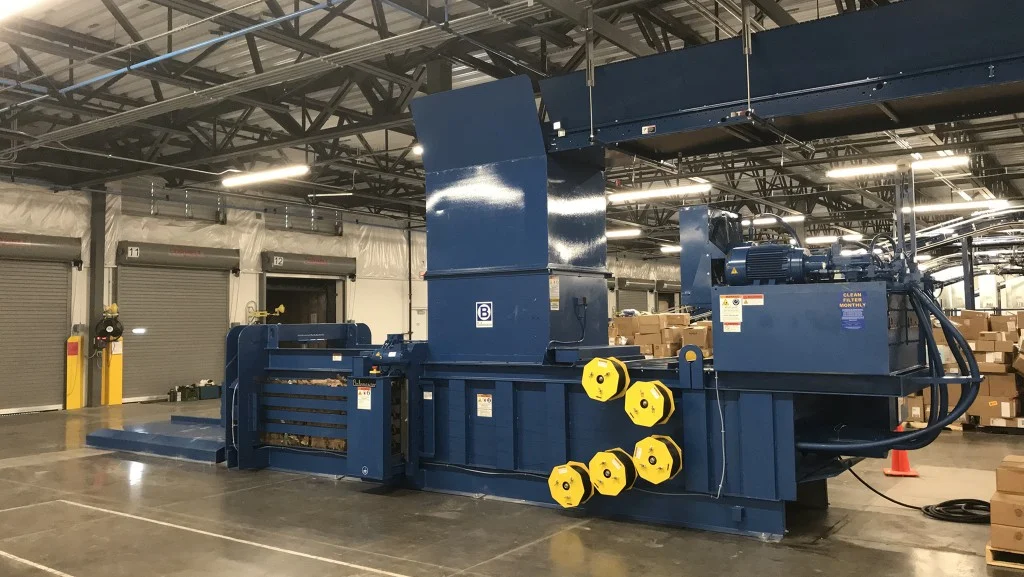
Above the manual-tie range, the labor of hand-tying every bale becomes the constraint, and a horizontal auto-tie baler takes over. The auto-tie wires each bale automatically as it forms, so the machine runs as fast as material reaches it. It can be fed by conveyor, cart dumper, forklift, or by hand, and handles high volume with minimal operator involvement.
Auto-ties are the standard answer for corrugated plants, printers, converters, and any manufacturer whose corrugated volume runs well beyond the manual-tie range. For dedicated trim streams, they pair directly with pneumatic trim systems so scrap goes from the production line to the bale without touching the floor.
Two Ram Balers: For Mixed Streams and Tougher Material
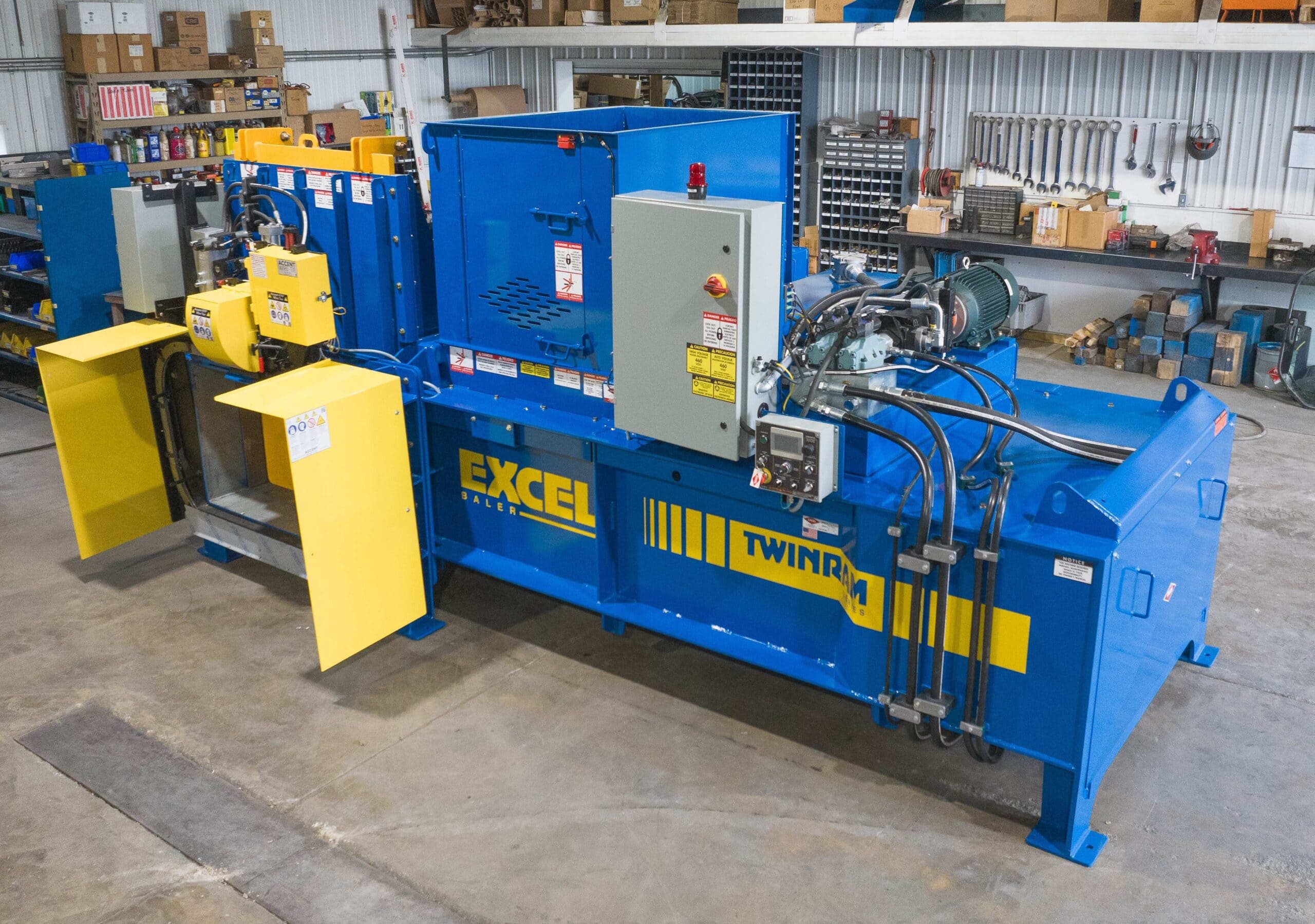
At higher volumes, or when the material gets tough or oversized, a two ram baler earns its premium. A two ram has a bale separation door that closes off one commodity so the machine can start on the next, which is why it moves between materials so cleanly: bale off the cardboard, and the next charge can be film or rigid plastics, with no mixed bale in between.
Two rams also bring the compression force and feed opening that tough or oversized material demands. Rigid plastics, corrugated, and oversized off-spec product that stall lighter machines are routine work for a two ram. Oversized material is its own reason plants land on a two ram: a large feed opening takes bulky scrap that will not fit a smaller chamber without someone breaking it down by hand first.
Matching Machine to Volume: The Quick Reference
| Machine | Fits best when | Feed method |
|---|---|---|
| Vertical baler | Cardboard, plastic film, up to roughly 1 to 2 tons per day | Hand-loaded |
| Horizontal manual-tie | Steady volume, roughly 2.5 to 5 tons per day; full eject models run cardboard and plastics | Hand, forklift, cart dumper, or conveyor |
| Horizontal auto-tie | High volume beyond the manual-tie range; dedicated trim streams | Conveyor, cart dumper, forklift, hand, or trim system |
| Two ram | High volume across mixed commodities; oversized material and rigid plastics | Conveyor |
Volume thresholds are a starting point, not a rule. Material mix, bale markets, labor cost, and floor space all move the line, which is why HMS specs from your actual scrap profile rather than a chart.
Integration: Getting Scrap to the Baler Without Labor
The machine is half the system. How scrap reaches it is the other half, and it is where manufacturers leave the most money on the table. Every cart trip to a hand-fed baler is labor spent on scrap instead of production. The fixes, in order of ambition:
- Infeed conveyors. A pit or above-ground conveyor lets workcells and forklifts dump scrap at floor level and meters it into the baler automatically. This is the single biggest labor reduction available in scrap handling.
- Trim system feeds. Converting and corrugated operations can duct pneumatic trim collection directly to the baler's charge chamber, so edge trim and skeletons never hit the floor.
- Placement. Sometimes the cheapest integration is layout: putting the baler where the scrap is generated, with the bale door facing the dock path, saves steps on every single bale.
HMS designs and installs all three, and rebuilds infeed conveyors in our own shop to pair with refurbished balers.
New vs. Refurbished for a Manufacturing Plant
Both paths are legitimate, and the right one comes down to volume, timeline, and how the plant plans capital. Here is how each stacks up.
New means the machine is built exactly to your application: chamber and feed opening sized to your material, the latest controls and hydraulics, current energy efficiency, and a full manufacturer warranty with the machine's entire service life ahead of it. For plants running high volume, integrating a baler into a new line, or standardizing on new equipment, that spec-it-exactly approach pays off for decades. HMS is an authorized dealer for Excel and Balemaster, so new machines come with factory support and our own installation and service behind them. The main planning factor is lead time, since new machines are built to order.
Refurbished means a proven machine rebuilt to run like it should: new liners, resealed or replaced cylinders, updated hydraulics and controls as needed, at a lower investment than new and often available sooner. HMS refurbished balers are rebuilt in our Wanatah, Indiana shop by the same technicians who service equipment in the field, and carry a 120-Day Parts and Labor Warranty.
The honest answer is that neither is the default. A plant adding its first horizontal might land on either depending on budget and timing, and plenty of operations run both, new where the spec demands it, refurbished where it stretches capital further. HMS quotes both paths side by side against your numbers so you can compare real machines, not categories. Browse current used and refurbished inventory to see what is in stock.
Frequently Asked Questions
What is the best baler for a manufacturing plant?
It depends on scrap volume and material mix. Plants generating cardboard occasionally are usually best with a vertical baler. Plants producing roughly 2.5 to 5 tons per day fit a horizontal manual-tie baler. Higher volumes justify a horizontal auto-tie machine, and closed door horizontals in full eject configurations handle mixed materials like cardboard and plastics, and at higher volumes or with oversized and tougher material, a two ram baler is often the right machine.
Can a baler pay for itself in a manufacturing plant?
Often, yes. A baler cuts hauling costs by densifying scrap that would otherwise ship as loose material in open-top containers, and baled commodities like OCC and non-ferrous trim can be sold rather than paid to haul away. Many manufacturers with steady cardboard volume have their baled OCC hauled at no cost, and higher-value streams generate revenue. Payback depends on volume, commodity mix, and local markets.
Can a baler be fed directly from a production line or trim system?
Yes. Balers are commonly integrated with infeed conveyors from workcells, and paper converting and corrugated operations often feed balers directly from pneumatic trim systems. This removes manual scrap handling from the floor and keeps the baler cycling on a steady feed. HMS designs and installs conveyor-fed and trim-fed baler systems.
Should a manufacturer buy a new or refurbished baler?
Both are good options, and the right choice comes down to volume, timeline, and budget. A new baler is built exactly to your application, with the latest controls, current energy efficiency, and a full manufacturer warranty, with build lead times to plan around. A refurbished baler delivers a lower investment and is often available sooner. HMS refurbished balers are rebuilt in our Wanatah, Indiana shop and carry a 120-Day Parts and Labor Warranty. HMS quotes both paths side by side so you can compare real machines against your numbers.
Bottom Line: Match the Machine to the Scrap, Then Take the Labor Out
The best baler for an industrial manufacturer is the one matched to what the plant actually generates: a vertical for occasional cardboard, a horizontal manual-tie in the 2.5 to 5 tons per day range, an auto-tie when volume runs past that, and and a two ram at high volume or when the material gets tough or oversized. Then finish the job with integration, conveyor or trim-fed, so scrap stops consuming labor on its way to the bale.
HMS specs, sells, installs, and services all four machine classes, new and refurbished, with conveyors and trim system integration handled by our own team. Tell us your scrap streams and daily volume, and we will match the machine to your plant.
What Does Your Plant Generate?
Send us your scrap streams and rough daily volume, and HMS will spec the right baler and feed system, with new and refurbished options quoted side by side.