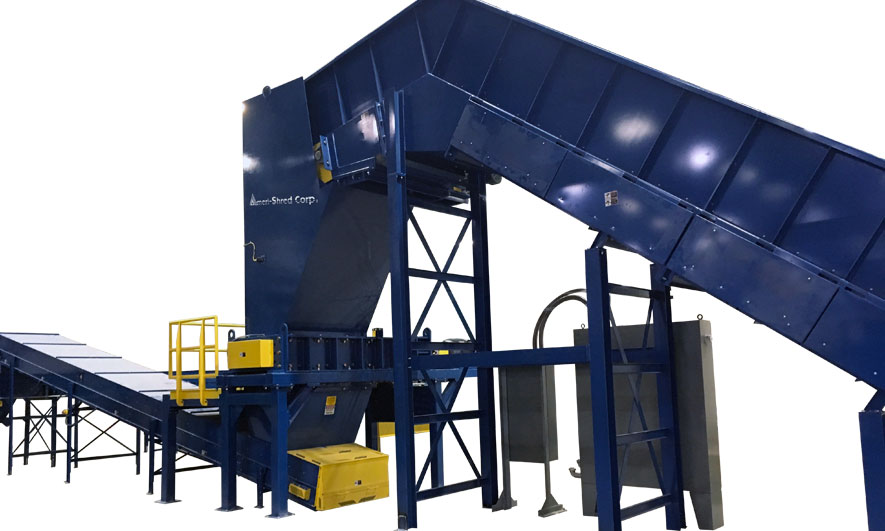
Most operations buy a shredder for one of two reasons: something needs to be destroyed, or something will not fit in the baler. Both are legitimate. But the operations getting the most out of a shredder are the ones who stopped thinking of it as a separate machine and started thinking of it as the front end of their baling line.
That shift matters because of what shredding does to a bale. Whole boxes, cores, and bulky scrap trap air. They bridge in the charge hopper, they tumble instead of feeding, and they leave voids in the chamber that no amount of ram pressure fills. Reduce that same material to uniform pieces and it packs. Bales get substantially denser, trailers leave heavier, and the number of hauls drops. The material did not change. The way it enters the baler did.
This guide covers how HMS specs industrial shredders for corrugated, paper and fiber, and plastics, how the shredder ties into conveyors and balers as one automated line, and how to pick between machine types. Secure destruction is part of the picture, but it is not the whole story, and for most plants it is not even the main one.
What Shredding Actually Buys You
Four things, in rough order of what shows up on the P&L first.
- Denser bales, fewer hauls. This is the big one. Uniform shredded material fills the baling chamber without voids, so each bale carries meaningfully more weight. Fewer bales per ton means fewer trailer loads, and freight is usually the largest ongoing cost in the whole scrap operation.
- No more infeed jams. Assembled boxes and bulky scrap bridge across the charge hopper and stall the cycle, which is why so many plants have someone standing at the baler with a pole. Shredded material feeds evenly. That labor goes away, and so does the safety exposure that comes with reaching into a baler.
- No size limit on what you can bale. With the right shredder in front of it, a baler stops caring how big the material is. Oversized cores, full sheets, and assembled cartons all become balable without anyone breaking them down by hand.
- Better commodity value on some grades. Cleaner, denser, more consistent bales grade better and ship better. On fiber especially, density is what the mill contract is written around.
The quick test: if anyone in your plant is flattening boxes, cutting down cores by hand, or clearing jams at the baler infeed, you are paying for a shredder in labor already. The only question is whether you would rather own one.
Design It as One Line, Not Three Machines
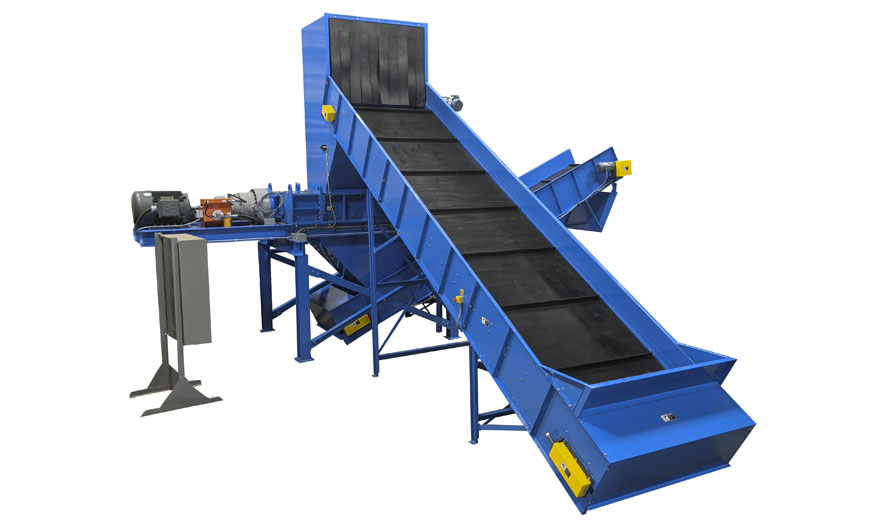
The mistake is buying a shredder and figuring out later how material gets in and out of it. An integrated system is designed as a single flow, with the controls tied together so each machine paces the next:
Interlocked controls let the shredder meter itself to the baler's cycle. Feed is steady, nothing floods, nothing starves, and the line runs with little to no operator attention.
A few design decisions shape that line:
Feed method
An infeed conveyor is what makes the system automatic. Pit or above-ground, it lets forklifts, workcells, or floor sweeps dump material at grade and meters it into the shredder hopper at a rate the machine can take. Gaylord box dumpers and cart dumpers work well where material is collected in gaylords or carts around the plant, and they take the lifting out of the process. Paper converting and printing operations often feed pneumatically, ducting trim directly from the production line so scrap never touches the floor.
Roll stock needs a step in front of the shredder
Full rolls do not go into a shredder. Butt rolls, mill rolls, and large roll stock have to be cut down first, which is what a roll splitter or guillotine is for. The full line looks like this: roll stock into the guillotine, cut material over to the shredder infeed conveyor, into the shredder, then shredder output conveyor either to the plant floor or directly onto the baler infeed conveyor, then baled. Printers, converters, and paper mills that handle roll stock should spec the guillotine and the shredder together, since sizing one without the other leaves a manual step in the middle of an otherwise automated line.
Where the shredder sits
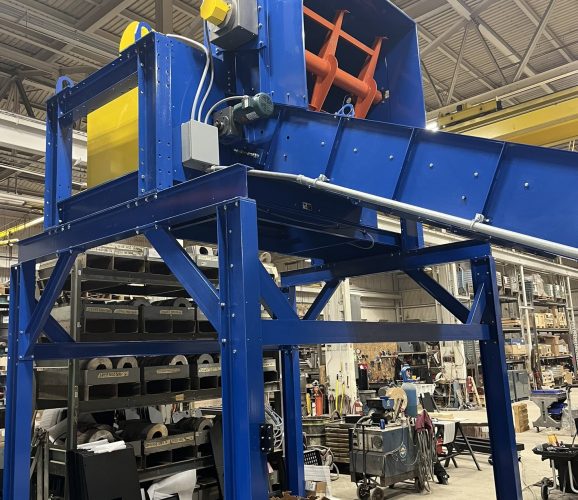
Triple shaft corrugated shredders are most commonly mounted directly above the baler, discharging straight into the charge chamber. That saves significant floor space and eliminates the discharge conveyor entirely, which is why it is the standard configuration for corrugated. Dual shaft and quad shaft shredders do not mount over a baler. They are floor-mounted machines that discharge to a conveyor, which then runs to the baler, a compactor, or wherever the material needs to go next.
Controls and interlocks
PLC control is what turns three machines into a system. Auto reverse clears a jam without an operator, high level shut-down stops the shredder when the baler chamber is full, and overload protection saves the drive when something unshreddable comes through. Without interlocks, you have a shredder that keeps running while the baler is mid-cycle, and someone has to babysit it.
The Three Machine Types and What Each Is For
HMS builds its shredder line around three machine types. Which one fits comes down to the material and whether the output needs to be a controlled size.
Corrugated shredders (triple shaft)
A triple shaft machine purpose-built for corrugated in every form: assembled boxes, flattened boxes, folding carton stock, and cores from 3 to 24 inches. A box crusher arm flattens folded boxes on the way in, and the machine is designed to mount above the baler and discharge directly into it. Minimal dust and quiet operation matter here, because these machines usually sit inside an occupied plant rather than in a yard.
| Model | Throat Width | Horsepower | Core Size | Approx. Weight |
|---|---|---|---|---|
| COR-3130 | 48 to 60" | 15 to 30 | 3 to 8" | 5,500 lbs |
| COR-3140 | 48 to 60" | 20 to 40 | 4 to 10" | 6,000 lbs |
| COR-3150 | 48 to 60" | 30 to 50 | 4 to 14" | 7,000 lbs |
| COR-3175 | 48 to 60" | 60 to 75 | 12 to 20" | 7,500 lbs |
| COR-31100 | 48 to 60" | 75 to 100 | 12 to 24" | 8,500 lbs |
Throughput runs roughly 1 to 10 tons per hour depending on the density and type of corrugated being processed. Common homes for these machines: distribution centers, folding carton facilities, automotive suppliers, core shredding operations, manufacturing plants, and recycling facilities.
Dual shaft shredders
The general-purpose primary size reduction machine, and the one that covers the widest range of material. Low speed, high torque design with in-line planetary drives puts maximum torque at the cutters, which is what lets a dual shaft shear tough material instead of just beating on it. Reduced noise, less downtime, and zero emissions from the drive.
The features that matter in daily operation are the ones that keep it running unattended: auto shaft reversal prevents overfeeding and protects the cutters when something unshreddable comes through, individual cleaning fingers keep material from wrapping and packing between the cutters, and bearing protection uses false walls and seals to keep shredded fines out of the bearings. These machines are built to order, sized to the particle size and throughput the application actually needs.
| Model | Horsepower | Chamber Size (W x L) | Drives |
|---|---|---|---|
| DS-15 | 10 or 15 | 16" x 21" | 1 |
| DS-20 | 20 | 24.25" x 26.5" | 2 |
| DS-30 | 30 or 40 | 23" x 30" | 1 |
| DS-55 | 45 or 55 | 24.25" x 26.5" | 2 |
| DS-60 | 45 or 55 | 28" x 36" | 2 |
| DS-75 | 50, 60 or 75 | 31" x 40" | 1 |
| DS-125 | 100 or 125 | 35" x 50" | 1 |
| DS-150 | 150 | 39" x 60" | 1 |
Applications run well past fiber: paper and pre-shredding tissue, plastics and nonconforming product, wood scrap, e-scrap and electric media, automotive parts, C and D waste, tires, and document and product destruction. Higher horsepower machines and full systems are available beyond this range.
Quad shaft shredders
Where a dual shaft makes material smaller, a quad shaft makes it a specific size. Four shafts plus a contoured sizing screen mean every piece coming out falls within a controlled particle size, with removable screens specified per application from half an inch up to 6 inches. That matters in two situations: when a destruction standard requires a defined particle size, and when downstream processing needs liberated, uniformly sized material for separation and sortation.
Low speed and high torque again, which means lower heat and dust generation than high speed shredders, plus a self-cleaning chamber and screen design.
| Model | Horsepower | Cutting Chamber | Particle Size | Machine Weight |
|---|---|---|---|---|
| QS-30 | 20 to 40 | 30" x 36" | 1/2" to 2" | 4,500 lbs |
| QS-100 | 80 to 120 | 38" x 38" | 1" to 4" | 14,000 lbs |
| QS-250 | 250 to 400 | 67" x 67" | 1-1/2" to 6" | 45,000 to 55,000 lbs |
All three models handle medical waste, plastics, metal scrap, e-scrap, paper, textiles, and wood, and all run on 460/3/60 power with overfeed and overload protection included.
Matching the Machine to Your Material
| If you are processing | Start with | Why |
|---|---|---|
| Corrugated boxes, cartons, cores | Triple shaft corrugated shredder | Purpose-built, box crusher arm, handles cores, mounts above the baler |
| Printers' waste, trim, die-cut skeletons | Triple shaft or dual shaft | Depends on material size and whether feed is pneumatic |
| Butt rolls and large roll stock | Guillotine, then shredder | Rolls must be cut down before any shredder will take them |
| Mixed fiber plus plastics on one machine | Dual shaft | Widest material range, built to order for the mix |
| Rigid plastics, purgings, nonconforming product | Dual shaft | High torque shears tough material rather than jamming on it |
| Anything needing a defined particle size | Quad shaft | Sizing screen delivers uniform output, 1/2" to 6" |
| Material for downstream separation | Quad shaft | Liberates material for more effective sortation |
Sizing the System So Nothing Bottlenecks
The shredder and the baler have to be sized to each other. A shredder that outruns the baler just builds a pile in front of it, and a baler waiting on an undersized shredder is expensive idle capacity. Work through these before anyone quotes a machine:
- Tons per hour at peak, not average. Shift-end cleanouts and heavy production days are the real load. Size to those.
- Your hardest material, not your easiest. Rated throughput on loose flattened corrugated and rated throughput on dense cores are different numbers on the same machine.
- Feed opening versus your largest piece. Throat width has to accept your biggest core, sheet, or carton without anyone pre-cutting it. This is where oversized material quietly forces a bigger machine, or a guillotine in front of it.
- Particle size the baler wants. Smaller is not automatically better. Over-shredding costs horsepower and wear for density gains the bale does not need.
- Electrical service and floor. Larger machines need substantial three-phase service, and a QS-250 class shredder is a 45,000 pound machine. Verify power and slab early.
New vs. Refurbished Shredders
Shredders sit a little differently from balers here. Because these machines are built to order around your material, particle size, and throughput, and because the system engineering is what makes them work, new is more often the right call than it is on a baler. A new machine gets cutter configuration, screen sizing, drive package, and controls matched to your application, with system engineers making sure the shredder and everything around it integrate cleanly.
That said, a rebuilt machine can be an excellent value when a good one matches your material and volume, and it usually ships sooner. HMS rebuilds equipment in our Wanatah, Indiana shop, and refurbished machines carry a 120-Day Parts and Labor Warranty. The practical approach is to tell us the application and let us quote both paths, since availability of a suitable used machine is what usually decides it. Browse current used and refurbished inventory to see what is in stock.
Frequently Asked Questions
Why shred material before baling it?
Shredding solves three problems at once. It produces significantly denser bales, because uniform pieces pack into the chamber without the voids that whole boxes, rolls, and bulky scrap leave behind. It eliminates baler infeed jams, since shredded material feeds evenly instead of bridging and tumbling in the charge hopper. And it removes the size limit on what you can bale, so oversized cores and assembled boxes no longer need to be broken down by hand first. Denser bales mean more weight per trailer and fewer hauls.
Can a shredder be tied directly into a baler and conveyor?
Yes, and that is how most shredders should be installed. A typical integrated line runs infeed conveyor to shredder to discharge conveyor to baler, with the controls interlocked so the shredder paces itself to the baler's cycle. Triple shaft corrugated shredders are most commonly mounted directly above the baler, which saves floor space and drops shredded material straight into the charge chamber. Dual shaft and quad shaft machines are floor-mounted and discharge to a conveyor instead. Properly designed and interlocked, these systems run with little to no operator attention.
What is the difference between a dual shaft and quad shaft shredder?
A dual shaft shredder is a primary size reduction machine. It shears material down for volume reduction, baling prep, and destruction across a wide range of materials, without targeting a precise output size. A quad shaft shredder adds a second cutting stage and a sizing screen, so every piece is reduced to a uniform particle size, typically specified between half an inch and six inches. Choose dual shaft when the goal is making material smaller and balable, and quad shaft when downstream processing, separation, or a destruction standard requires a controlled particle size.
What materials can an industrial shredder process?
Industrial shredders handle corrugated in every form including assembled boxes, flattened boxes, folding carton stock, and cores from 3 to 24 inches on a triple shaft machine; paper and fiber including printers' waste, trim, and die-cut skeletons, with butt rolls and large roll stock cut down by a guillotine first; plastics including film, rigids, purgings, and nonconforming product; plus wood scrap, e-scrap, tires, C and D waste, and product requiring secure destruction. HMS specs the machine to the material rather than the other way around.
How much throughput does an industrial shredder deliver?
It depends on the machine and the material. HMS corrugated shredder models range from roughly 1 to 10 tons per hour depending on the density and type of corrugated being processed, with 15 to 100 HP and 48 to 60 inch throat widths. Dual shaft models run from 10 HP up to 150 HP, and quad shaft models from 20 HP to 400 HP. Throughput should be matched to the baler downstream, since a shredder that outruns the baler simply creates a pile.
Bottom Line: The Shredder Is Part of the Baling Line
A shredder bought as a standalone machine solves one problem. A shredder designed into the line, fed by conveyor, interlocked to the baler, sized to the material, changes the economics of the whole scrap operation: denser bales, fewer hauls, no jams, no one breaking down boxes by hand, and no ceiling on what you can process.
HMS specs, sells, installs, and services complete shredding and baling systems, including shredders, balers, conveyors, controls, and integration, with our own crews handling rigging, installation, start-up, and operator training. Tell us your material and volume, and we will design the line around it.
Thinking About Adding a Shredder?
Whether it ties into an existing baler or comes as a complete new line, HMS will spec the shredder, conveyors, and controls around your material and throughput.