Balemaster has been building horizontal auto-tie balers in Crown Point, Indiana for decades, and the lineup can be confusing from the outside: E-Series, EO-Series, 5200 Series, and dozens of model numbers within them. The good news is that it organizes cleanly once you know the system - three series that differ by bale size, charge chamber, and cylinder diameter, with a model number that tells you each machine's capacity. This guide walks through what each series is built for and the specs that matter when you are comparing them. One note up front: Balemaster builds a wide range of models and configurations within every series, so whatever your volume calls for, a machine exists for it - call us and we will spec it.
HMS is an authorized Balemaster dealer based in Wanatah, Indiana - about 30 miles from the Balemaster factory. We sell, install, and service the full Balemaster lineup across North America, and tie machines into existing plant systems for distribution centers, box plants, printers, and converters.
The Model Number Is a Capacity Rating
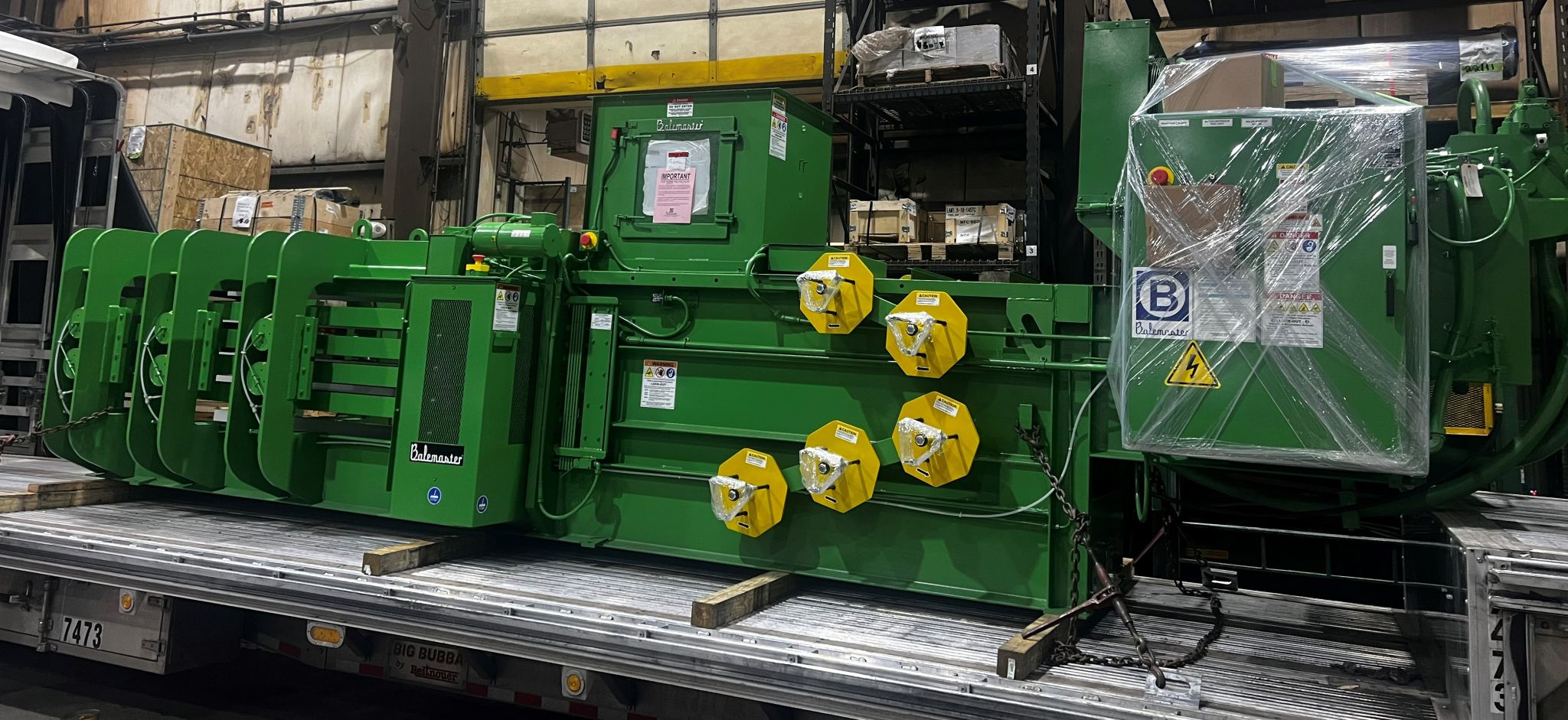
Start here, because it makes the rest of the lineup easy to read: add a zero to any Balemaster model number and you get the machine's dry material throughput in cubic feet per hour at no load. A machine numbered in the 800s moves roughly 8,000-plus cubic feet per hour. A machine numbered in the 2000s moves over 20,000. The bigger the number, the faster the machine clears material.
That means comparing Balemaster machines is mostly a matter of knowing your own hourly material volume. Once you know roughly how many cubic feet of trim, cartons, or paper your operation generates per hour, the model number narrows the lineup to a couple of candidates before you ever look at a spec sheet.
The second thing to know: within a series, machines of the same bale size share the same chamber and construction - the steps between models are hydraulic power. More horsepower means faster ram cycles and more strokes per minute, which is what moves more material per hour through the same chamber. Pick the series and bale size first, then pick the horsepower that matches your volume.
The Three Series
Balemaster's auto-tie lineup breaks into three series. Bale length is fully adjustable on all of them - bale cross-section, charge chamber, and cylinder diameter are what separate the series.
The E-Series is the flagship of Balemaster's auto-tie line and the machine a large share of printers, paper converters, envelope plants, carton plants, and box plants run. It comes in two bale sizes - a compact 30 x 36 inch bale for tight footprints and moderate volume, and the mainline 36 x 40 inch bale that improves freight economics while keeping a mid-size footprint. Hydraulic power scales from 25 HP up to 150 HP, with the fastest machines cycling in under 5 seconds and clearing roughly 30,000 cubic feet per hour. For steady, continuous plant-floor volume fed by hand, conveyor, or air system, the E-Series is the default answer.
The EO-Series is the oversize hopper line - larger bales, larger charge chambers, and the widest range in the lineup. Bale sizes include 43 x 43, 44 x 30, and 48 x 40 inches, with ram cylinders in 8-inch, 10-inch, and 12-inch configurations. At the top of the series, the heaviest 12-inch machines run up to 225 HP and deliver up to 339,300 pounds of thrust - 169.7 tons - from an 85 cubic foot charge chamber, producing maximum-density bales at rates approaching 46,000 cubic feet per hour. The oversized charge chamber is also a layout solution: as we covered in our box plant guide, plants that cannot put an air system silo on the roof often choose an EO machine because the chamber itself buffers surges from the trim system. High-volume box plants, distribution centers, corrugated recyclers, and MRFs live in this series.
The 5200 Series is Balemaster's high-capacity line, built around an oversized "wide-mouth" feed chute and the largest charge chambers in the lineup - 77.5 cubic feet on 8-inch cylinder machines and 94.1 cubic feet on 10-inch machines, behind feed chutes up to 45.5 x 75 inches. That geometry is the point: the wide mouth and huge chamber let the 5200 swallow everything from upright cartons and whole boxes to shredded material without bridging, with the fastest machines cycling in under 9 seconds. For large, high-density bale production where surge volumes are the daily reality, this is the machine.
The Lineup at a Glance
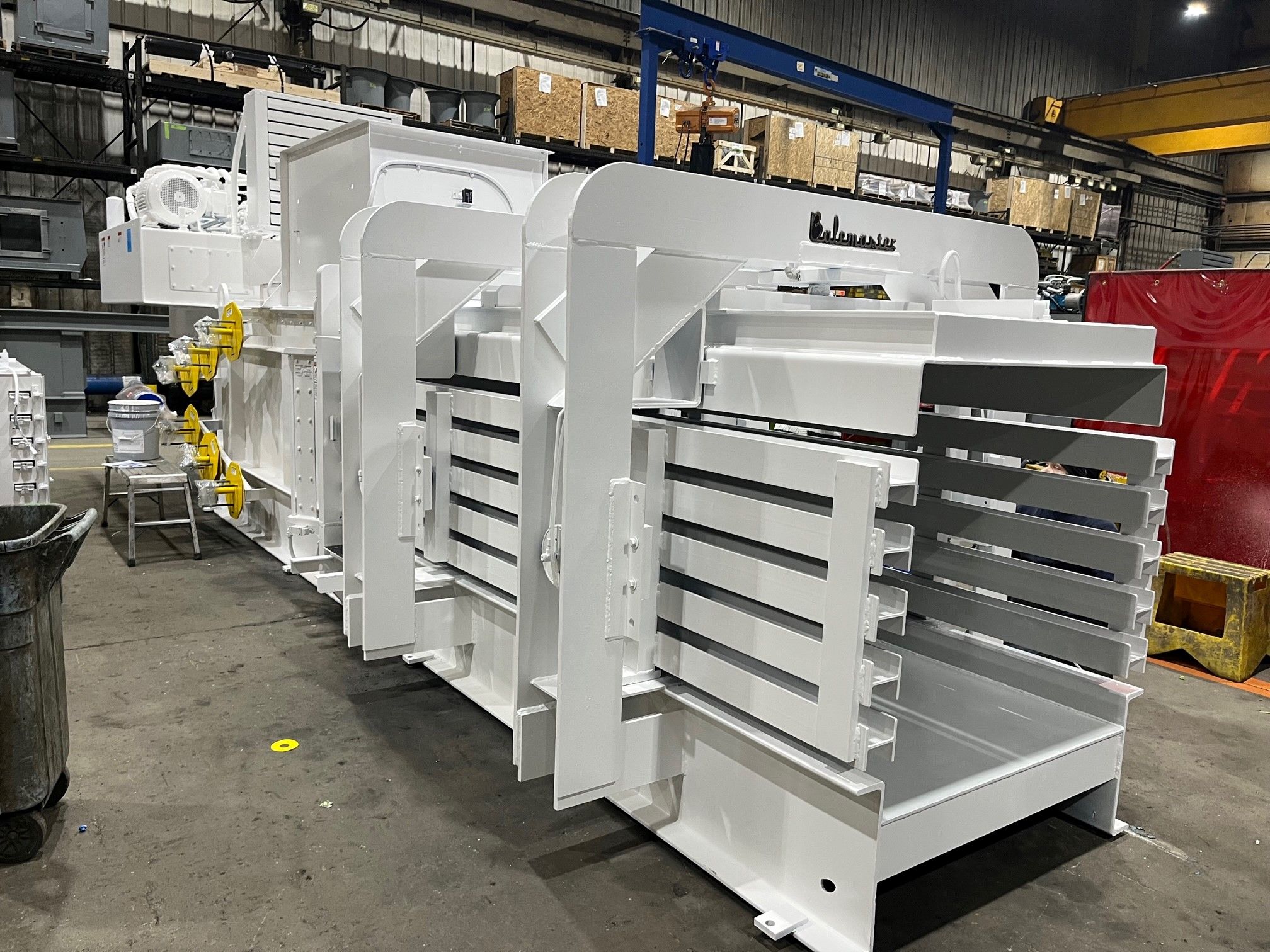
| Series | Bale sizes | Cylinder | Power | Best fit |
|---|---|---|---|---|
| E-Series | 30" x 36" and 36" x 40" | 6",8", or 10" | 25 - 150 HP | Printers, converters, box plants - the flagship line |
| EO-Series | Including 43" x 43", 44" x 30", 48" x 40" | 8", 10", or 12" | 30 - 225 HP | High-volume plants, recyclers, distribution centers, no-rooftop-silo layouts |
| 5200 Series | 48" x 40" | 8" or 10" | 30 - 150 HP | Wide-mouth feed, surge-heavy and mixed-form material |
Balemaster builds a wide range of models within each series - different horsepower steps, cylinder configurations, and bale sizes beyond what is summarized here. Rather than picking a model number from a chart, tell HMS your material and hourly volume and we will spec the exact machine. As the dealer 30 miles from the factory, we can do it quickly.
What Every Balemaster Shares
Across all four groups, the feature set that defines a Balemaster is standard:
- Heavy-duty automatic wire-tier - a sub-30-second tie-off cycle, with on-board wire coil management keeping the tie system fed and consistent.
- Automatic bale density control - the machine regulates its own squeezing force, which is what lets it handle wax-coated, laminated, and "slick" materials with no operator adjustments. Configuration scales by group, from quad 6-inch cylinders on the E machines to six 6-inch cylinders on the EO group.
- Touchscreen controller - a comprehensive programmable interface with more than 50 information screens, including bale tying length adjustable in 1-inch increments.
- Trunnion-mounted main hydraulic cylinder - cylinder options across the lineup run 6 to 14 inches depending on configuration.
- Energy-saving hydraulics - pump start/stop energy saver, dual vane pumps, and regenerative circuits across the power range of 25 to 225 HP.
- Standard dust control - a fully enclosed ram chamber whose seal is only broken during the tie cycle, plus a ram wiper and filtered hydraulic tank breather. In a trim-heavy plant, this matters daily.
- Heavy-duty welded steel construction - with replaceable ram liners and rollers and replaceable ram shear tips, so wear components are serviceable rather than structural.
illumen.X: Balemaster's Monitoring System
The newest addition to the Balemaster platform is illumen.X, an IIoT monitoring dashboard that changes how a baler gets maintained. Instead of running the machine until something fails, illumen.X tracks the components that actually wear and tells you when they are approaching service.
The system monitors wear components by bale count - ram rebuilds, top liners, ram wipers, wire feed rollers, auto-tie rebuilds - and fluid life by pump hours, covering oil changes, oil filters, and air breathers. Each component has a configurable service threshold, and when one approaches its limit, the system automatically sends email or SMS alerts to the right people. Lifetime bale count and baler hours run on non-resettable counters, so the machine's true history is always visible.
Beyond scheduled maintenance, illumen.X logs fault events in real time - hot oil, low oil, false cycling, incomplete ram cycles, incomplete auto-tie cycles - and triggers immediate alerts when they occur. And when something does need troubleshooting, a user at the touchscreen can send an I/O snapshot to Balemaster, letting factory support see exactly what the machine sees - stuck switches, failed valves - without needing access to the plant's network.
Here is why this matters in practice: the components illumen.X tracks by bale count - ram liners, top liners, rebuilds - are exactly the wear items that determine when a baler needs shop attention. Watching them by actual bale count instead of waiting for declining performance converts maintenance from reactive to planned, which is the difference between scheduled service on your calendar and a breakdown on the machine's schedule. It is the same principle behind why timely relines protect a machine - now with the machine reporting its own wear.
Why Buy Balemaster Through HMS
Balemaster builds its balers in Crown Point, Indiana. HMS is in Wanatah - about 30 miles down the road. That proximity is a practical advantage: factory support, parts, and technical resources are local for us in a way they are not for dealers hundreds of miles away, and it shows in how quickly things get resolved.
Beyond proximity, HMS handles the full scope of work: we help you match the right baler to your material and volume, we install with our own team, and we service what we sell. If a Balemaster is the right machine for your operation, we will spec the exact model - and if it is not, we carry other lines and refurbish equipment in-house, so the recommendation you get is the machine that fits.
Ready to spec a Balemaster for your operation?
Tell us your material, your hourly volume, and your layout - we will match you to the right group and model, plan the air system tie-in if you have one, and give you a straight quote. HMS is an authorized Balemaster dealer serving North America from Wanatah, Indiana.
Call (219) 733-2108 or contact us online.
Frequently Asked Questions
The Balemaster model number encodes the machine's capacity: add a zero to get cubic feet per hour of dry material throughput at no load. A machine numbered in the 800s moves roughly 8,000-plus cubic feet per hour, while a machine numbered in the 3000s moves over 30,000. Match the number against your hourly material volume and you can quickly narrow the lineup to the machines sized for your operation.
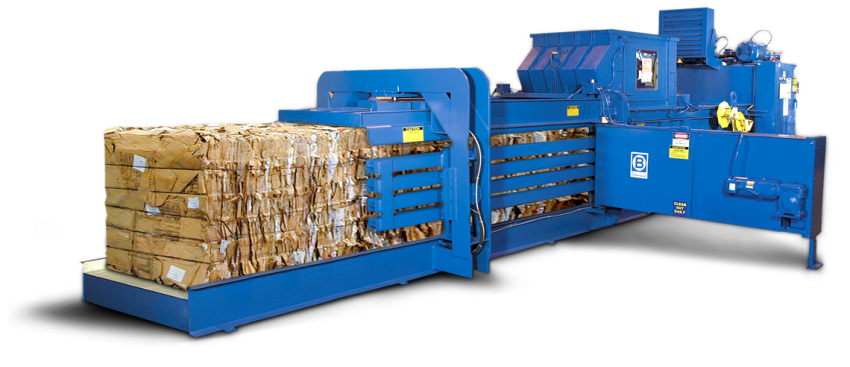
The practical difference is bale size, charge chamber volume, and cylinder diameter. E-Series machines produce 30 x 36 inch or 36 x 40 inch bales from charge chambers of roughly 24 to 33 cubic feet with 6", 8", or 10" cylinders - sized for printers, converters, and plants with moderate continuous volume. EO-Series machines use oversize hoppers and larger chambers, producing bale sizes including 43 x 43, 44 x 30, and 48 x 40 inches with 8-inch, 10-inch, or 12-inch cylinder options - the largest machines run up to 225 HP. The 5200 Series adds an oversized wide-mouth feed chute with the largest charge chambers in the lineup. All share the same automatic wire-tier, touchscreen controls, and bale density control system.
illumen.X is Balemaster's IIoT monitoring dashboard for its balers. It tracks critical wear components by bale count - ram rebuilds, top liners, wire feed rollers - and fluid life by pump hours, sending automatic email or SMS alerts when a component approaches its service threshold. It also logs faults like hot oil or incomplete auto-tie cycles in real time, and lets a user send an I/O snapshot to Balemaster for remote troubleshooting. The goal is converting baler maintenance from reactive to proactive.
Balemaster balers are sold through authorized dealers. HMS is an authorized Balemaster dealer based in Wanatah, Indiana - about 30 miles from Balemaster's Crown Point factory - and sells, installs, and services the full E-Series, EO-Series, and 5200 Series lineup across North America, including tying machines into existing plant air systems.
Bottom Line
Pick the series, then match the number to your volume
The Balemaster lineup reads simply once you know the system: three series separated by bale size, charge chamber, and cylinder diameter, with model numbers that tell you each machine's hourly capacity. The E-Series carries most printers, converters, and box plants. The EO-Series steps up to oversize hoppers, bigger bales, and the heaviest machines in the lineup - up to 225 HP and 169.7 tons of thrust - and solves the no-rooftop-silo layout problem with its larger charge chambers. The 5200 Series takes on surge-heavy, mixed-form material with its wide-mouth chute. Across all of it, the auto wire-tier, bale density control, dust control, and now illumen.X monitoring come standard.
For which machine fits which application in more depth, see our guides to the corrugated baler, the paper baler, and box plant recycling equipment. And when you are ready to talk models, HMS is the authorized dealer 30 miles from the factory - call us with your material and volume and we will spec the right machine.
Tell us your material, hourly volume, and layout - we will match you to the right Balemaster model and give you a straight quote.